

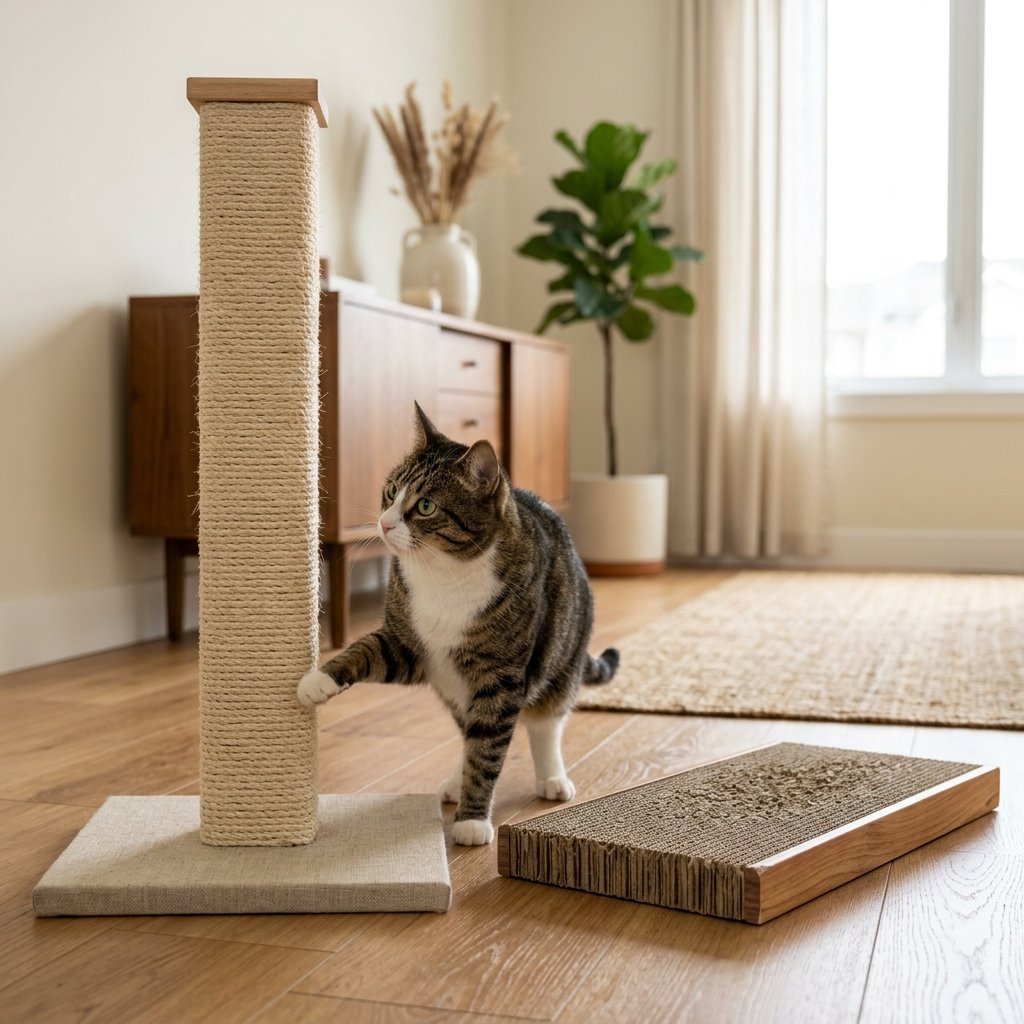
This is why just telling your cat to stop will rarely work, as scratching is one of the most natural things that cats do. Cats scratch to stretch their bodies, to keep their claws in good order, to leave scent marks from glands in their paws, and to communicate with their environment.
So the goal here is not to stop scratching. It is to redirect your cat to more appropriate places to scratch and make furniture and other undesired places less desirable.
If your cat has identified the sofa, carpet, curtains, or door frame as the place to scratch, the right combination of scratching posts, placement, rewards, and environmental changes can make a big difference.
Why Do Cats Scratch?
Cats scratch because scratching fulfills several normal physical and behavioral needs.
It allows cats to stretch out their shoulders, legs, and back, and gives them a chance to work their claws on a textured surface. Scratches also serve to communicate: the scent glands in the paws can leave chemical signals, and visible scratch marks can act as territorial signals.
That is why punishment is usually the wrong way to go. It’s not that your cat is being “bad” when it scratches your couch. It is just doing what it normally does, just in a location that is not convenient for you.
A more effective approach is to ask:
What does my cat like about this particular scratching surface?
Look at the location and the surface carefully. Your cat may prefer:
- Vertical scratching
- Horizontal scratching
- Rough fabric
- Sisal rope
- Cardboard
- Wood
- A particular height or angle
Once you identify that preference, you can offer a more appropriate alternative.
How to Stop a Cat From Scratching Furniture
The most reliable strategy is redirection rather than suppression.
Give your cat an appealing place to scratch, put it close to the unwanted target, and gradually make the furniture less rewarding to use. ASPCA and Cornell both recommend matching the scratching post to the cat’s preferred surface and orientation.
Here are eight practical steps that work together.
1. Choose the Right Scratching Post
A scratching post is only useful if your cat actually wants to use it.
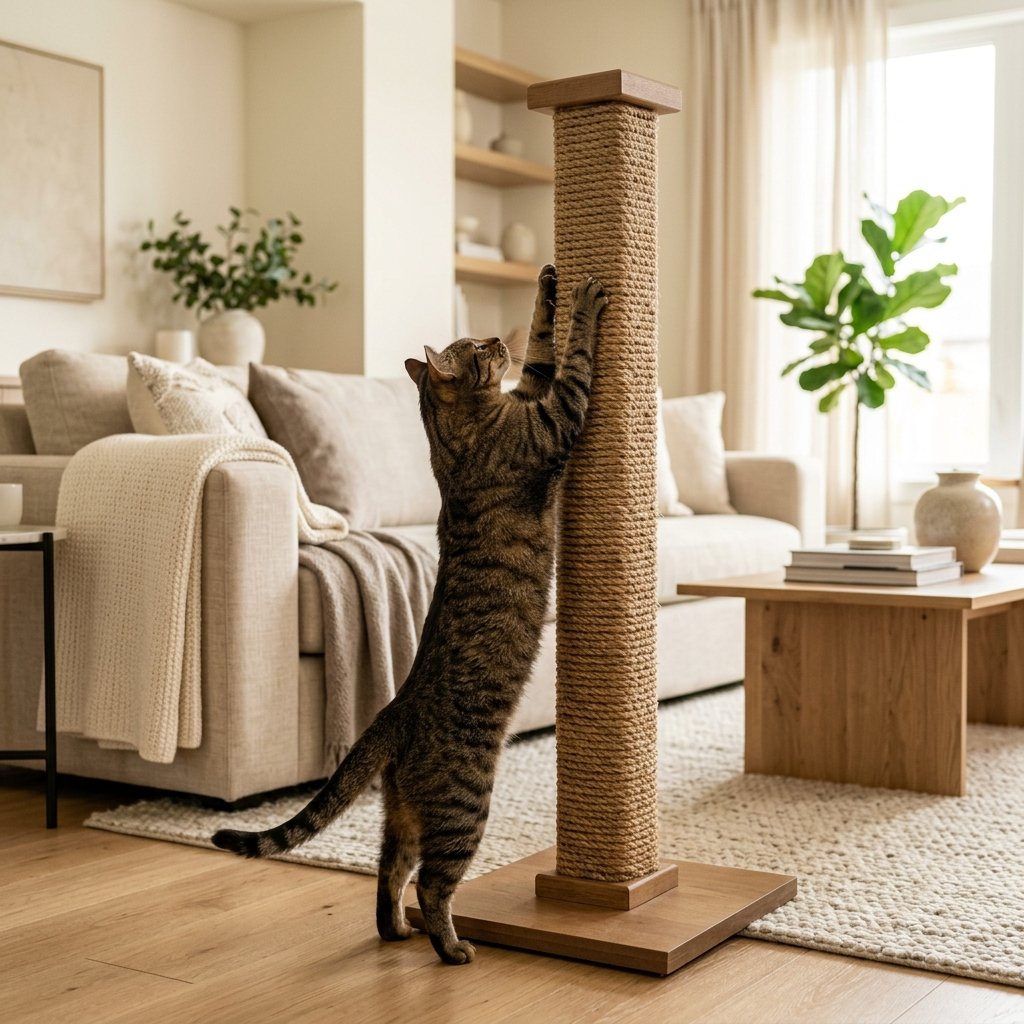
Pick a post that will allow for a full-body stretch for a vertical scratcher. Cornell suggests that a vertical scratching post should be tall enough for the cat to stretch its front legs up. The frame also needs to be sturdy enough so that it doesn’t wobble or fall over when the cat leans into it.
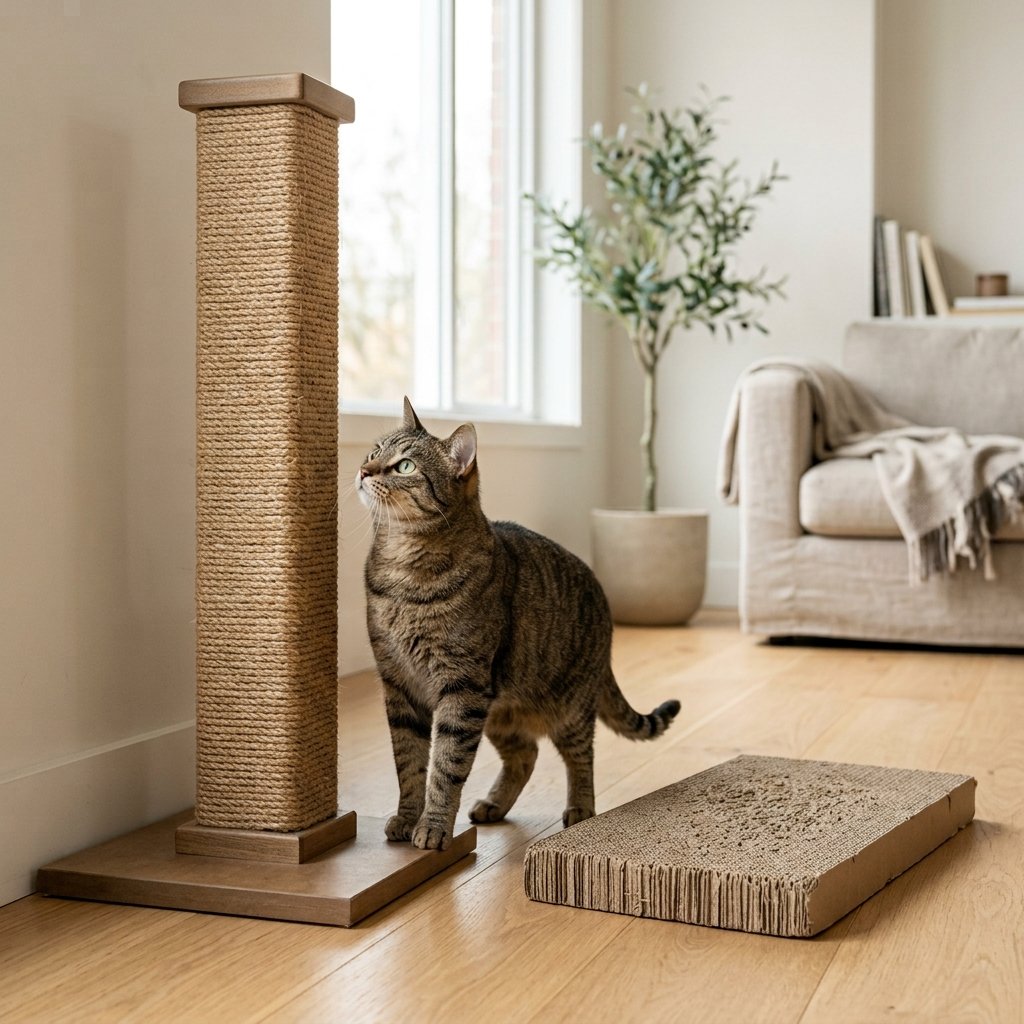
If your cat scratches the carpet or some other horizontal surface, a flat cardboard scratcher or horizontal scratching pad may be a better fit.
Match the surface to the behavior
| If your cat scratches… | Try offering… |
|---|---|
| Sofa fabric | Sisal or a sturdy fabric-covered scratcher |
| Carpet | Horizontal cardboard or carpet-style scratcher |
| Curtains | Tall vertical scratching post |
| Wooden furniture | Wood or textured scratcher |
| Floor rugs | Horizontal scratching pad |
The important point is not to assume that every cat likes the same scratching post.
Some cats prefer vertical surfaces, while others strongly prefer horizontal ones. Providing different textures and orientations can help you discover what your cat actually prefers.
2. Put the Scratcher Where Your Cat Already Scratches
Placement can matter just as much as the scratching post itself.
If your cat is scratching the arm of the sofa, place the scratching post right next to that spot. If your cat scratches at a door, put a suitable scratcher up next to it.
It works because you’re redirecting an existing habit instead of asking your cat to learn a brand new one.
Once your cat is using the scratcher on a regular basis, you can gradually move it to a more convenient location.
If your cat scratches in a few different locations, it might be better to provide a scratching option near each frequented location, rather than assuming that one post in another room will fix everything.
3. Make Furniture Less Attractive
While introducing an appropriate scratcher, make the unwanted surface temporarily less appealing.
Depending on the furniture and your cat, you can use protective coverings or double-sided tape on areas that are being scratched. ASPCA specifically lists covering or protecting desirable scratching targets as a way to discourage inappropriate scratching.
At the same time, place the preferred scratching surface directly beside the protected furniture.
The idea is simple:
Make the furniture inconvenient and the scratcher convenient.
Avoid creating a situation where the only available scratching option is somewhere your cat rarely visits.
4. Reward the Behavior You Want
When your cat uses the scratching post, reinforce that choice.
You can use:
- Small treats
- Praise
- Gentle attention
- A favorite toy
- Catnip, if your cat responds to it
ASPCA and Cornell both describe using treats, toys, praise, or catnip to encourage cats to investigate and use scratching posts.
Timing matters. Reward your cat shortly after the desired behavior so the connection is clear.
You do not need to make the training complicated. The goal is simply to make the appropriate scratching location rewarding enough that your cat chooses it again.
Don’t force your cat’s paws onto the post
Avoid grabbing your cat’s paws and rubbing them against the scratching surface.
This can make the post feel threatening rather than attractive. ASPCA specifically advises against forcing a cat to scratch by dragging its claws across the post.
Let the cat discover the surface voluntarily.
5. Keep Your Cat’s Claws Trimmed
Regularly trimming a cat’s nails can help minimize the amount of damage when the cat scratches furniture.
But it is not an alternative to a scratching post. The damage can be repaired with claw trimming, but the root behavioral need can be addressed with an appropriate scratching surface.
When trimming, remove only the sharp tip, and avoid the quick, the sensitive inner portion of the claw that contains blood vessels and nerves. If the cat won’t tolerate having its nails trimmed, ASPCA recommends clipping carefully or getting professional help.
If your feline gets stressed out when you trim its nails, don’t push it. Seek help from your vet or a professional groomer.
6. Add More Scratching Opportunities
One scratching post may not be enough, especially in a larger home or a household with multiple cats.
Think about where your cat naturally spends time.
Useful locations can include:
- Near a favorite sleeping area
- Beside furniture the cat already scratches
- Near a frequently used doorway
- In an area where the cat regularly stretches or plays
- Near another commonly used scratching location
Cats often scratch when they wake up or are active, so it can be particularly useful to have a scratcher near a favorite resting place.
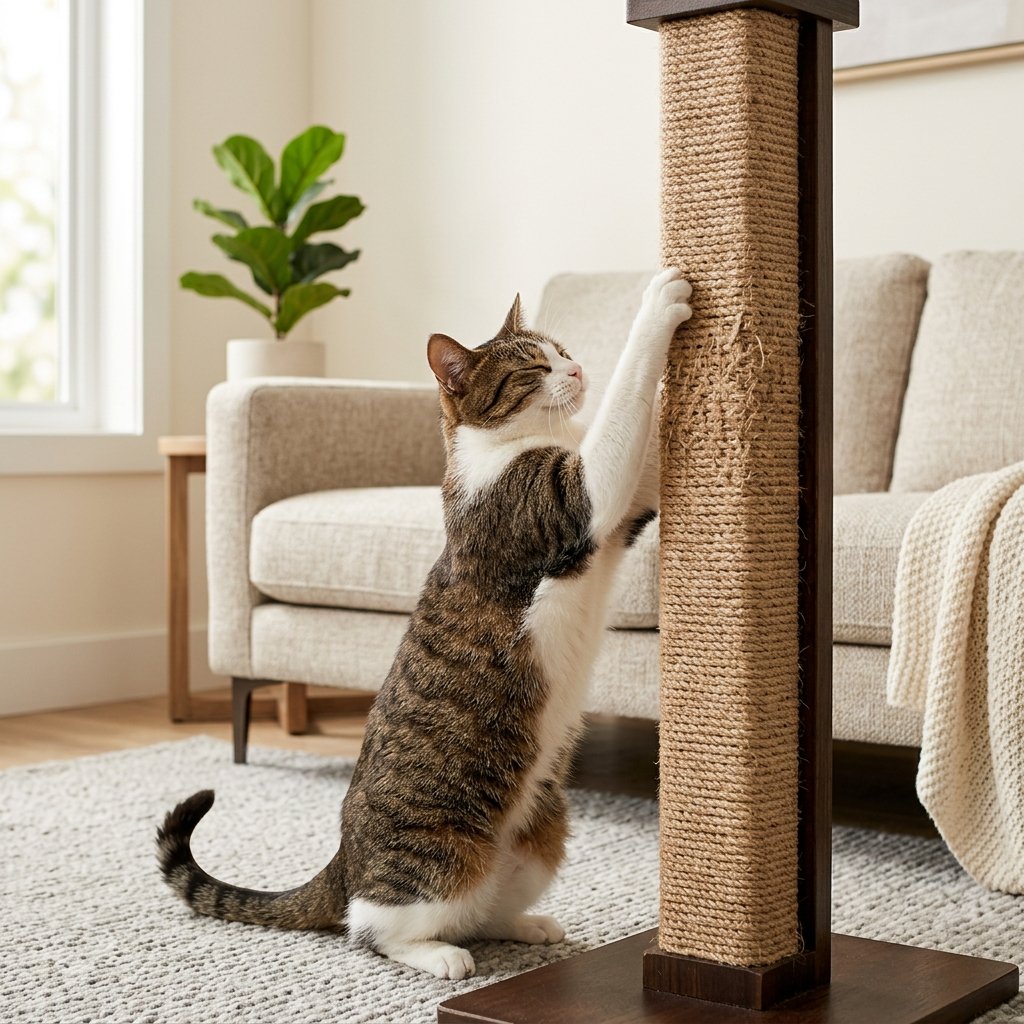
And a scratcher doesn’t have to be beautiful forever either. A battered, shredded post may actually be a successful post because the cat has already claimed it as a preferred scratching surface. ASPCA specifically states that cats may prefer familiar, well-used scratching posts.
7. Avoid Punishment
Yelling, hitting, chasing, or repeatedly startling your cat is not a good way to teach appropriate scratching.
Cornell notes that punishment can cause fear and may not teach the cat which behavior you actually want instead. A cat may simply learn to avoid scratching when you are present.
Instead of focusing on punishment, change the environment:
- Interrupt access to the unwanted surface when practical.
- Provide an appealing alternative.
- Place the alternative near the original target.
- Reward its use.
- Repeat consistently.
This teaches your cat where to scratch, rather than merely teaching it that scratching in front of you leads to an unpleasant experience.
8. Be Patient and Consistent
Cats do not all switch scratching locations immediately.
Cats often scratch when they wake up or are active, so it can be particularly useful to have a scratcher near a favorite resting place.
And a scratcher doesn’t have to be beautiful forever either. A battered, shredded post may actually be a successful post because the cat has already claimed it as a preferred scratching surface. ASPCA specifically states that cats may prefer familiar, well-used scratching posts.
Common Scratching Problems and Solutions
My cat ignores the scratching post
The post may not match your cat’s preferences.
Try changing one variable at a time:
- Vertical instead of horizontal
- Horizontal instead of vertical
- Sisal instead of cardboard
- Cardboard instead of sisal
- Taller instead of shorter
- Heavier and more stable instead of lightweight
Observation is more useful than buying increasingly expensive scratchers without changing the underlying setup.
My cat scratches the sofa even though I bought a scratcher
Move the scratcher directly beside the area being scratched.
The sofa may have the exact combination of height, texture, stability, and location your cat prefers. Put the alternative close enough that switching requires almost no effort.
Once the scratcher is being used reliably, move it gradually if necessary.
My cat scratches the carpet
A vertical post may not be the right solution.
Try a horizontal scratcher that allows your cat to perform the same paw movement it already prefers.
Cornell specifically recommends matching the scratching orientation to the cat’s established behavior.
My cat scratches curtains
Your cat may be looking for a tall vertical surface that allows a full stretch.
A tall, stable scratching post positioned near the curtain can provide a safer alternative. Once the post becomes the preferred scratching location, make the curtain less accessible if necessary.
My cat scratches several pieces of furniture
Instead of concentrating on one scratching post, provide several appropriate scratching surfaces in the areas your cat uses most.
Multiple scratching locations can be especially useful when the cat is marking or scratching around different parts of the home.
Should You Use Catnip on a Scratching Post?
Some cats may be attracted to a scratching post with catnip, but not all cats respond to it.
If your cat is responsive to catnip, a little sprinkled on or near the scratching surface may help increase interest. So, how do you get a cat to check out a scratching post? Both Cornell and the ASPCA suggest catnip as one possible method.
If your cat doesn’t respond to the catnip, there’s no point in continuing to use it. A good texture, stable construction, and good placement are more fundamental.
What Not to Do When Training a Cat to Stop Scratching
Avoid these common mistakes:
- Do not punish your cat for scratching.
- Do not force the cat’s paws onto the scratching post.
- Do not expect one type of scratcher to suit every cat.
- Do not place the only scratching post far away from the areas your cat uses.
- Do not immediately throw away a heavily used scratching post simply because it looks worn.
- Do not rely only on nail trimming to solve the behavior.
The objective is not to suppress a normal feline behavior. It is to give that behavior a suitable outlet.
When Should You Talk to a Veterinarian or Behavior Professional?
If your cat is scratching and also acting out of character, is very anxious, is aggressive, is visibly distressed, or is making dramatic changes in the way your cat normally acts, contact a veterinarian.
A veterinary behavior professional can also be a good resource if environmental changes and providing appropriate scratching options do not resolve a persistent problem. “If you have difficult destructive behaviors, then professional help with behavior is appropriate,” Cornell says.
Also be aware that scratching furniture is not the same as excessive scratching of the skin. If your cat is repeatedly scratching its body, especially if it is accompanied by hair loss, redness, swelling, scabs, or other skin changes, this may be a sign of an underlying skin problem rather than normal scratching behavior.
Frequently Asked Questions
How do I stop my cat from scratching furniture?
To stop a cat from scratching furniture, provide a scratching surface that matches its preferred texture and orientation, place it beside the furniture, and reward the cat for using it. Making the furniture temporarily less attractive can reinforce the change.
Why does my cat keep scratching the couch?
Your cat might keep scratching the couch because the couch offers a good combination of texture, stability, location, and height for the cat. Scratching also has normal stretching and scent-marking functions, so redirecting the behavior is generally more effective than trying to eliminate it.
What type of scratching post do cats prefer?
Not all cats like the same scratching post. Some like tall vertical posts and some like horizontal scratchers. Some cats may like different materials such as sisal, cardboard, wood, or some textured fabric.
How tall should a cat scratching post be?
A vertical scratching post should be tall enough for the cat to stretch upward with its front legs extended. It should also be stable enough that it does not wobble or tip when the cat scratches.
Can I train an older cat to use a scratching post?
Yes, an older cat can often be redirected to an appropriate scratching surface. The key is to identify the type of surface and orientation the cat already prefers and provide a suitable alternative in a convenient location.
Should I punish my cat for scratching?
No. Punishing a cat for scratching can create fear without teaching the cat where it should scratch instead. Redirecting the behavior and rewarding appropriate scratching is a more constructive approach.
Does trimming a cat’s claws stop scratching?
No. Nail trimming can reduce the damage caused by scratching, but it does not remove the underlying reasons cats scratch. Cats still need appropriate opportunities to perform this normal behavior.
How long does it take to stop a cat from scratching furniture?
There is no universal timeline because cats differ in their preferences and established habits. Progress generally depends on how well the new scratching surface matches the cat’s preferences and how consistently the environment is managed.
Image SEO Suggestions
Main Image
- Image subject: A cat using a tall sisal scratching post beside a sofa in a bright, tidy living room
- Filename:
how-to-stop-a-cat-from-scratching-furniture.jpg - Alt text:
Cat using a scratching post beside a sofa to avoid scratching furniture
Secondary Image
- Image subject: Close-up comparison of vertical and horizontal cat scratching surfaces
- Filename:
vertical-horizontal-cat-scratching-posts.jpg - Alt text:
Vertical and horizontal scratching posts for cats with different scratching preferences
Training Image
- Image subject: Cat receiving a small treat immediately after using a scratching post
- Filename:
reward-cat-for-using-scratching-post.jpg - Alt text:
Cat being rewarded after using a scratching post
Final Tips
The first thing I recommend when learning how to stop a cat from scratching is to change the question from “How do I stop this behavior?” to “What is my cat trying to accomplish, and where can he do so safely?”
Provide your cat with a consistent scratching surface that matches the location and texture of the target area, place it near the target furniture, make the furniture less appealing, and reward good scratching behavior.
If you set it up properly, you aren’t fighting your cat’s natural behavior; you’re giving it a better place to express it.
Sources
- ASPCA — Destructive Scratching.
- Cornell Feline Health Center — Feline Behavior Problems: Destructive Behavior.
- ASPCA — Cat Grooming Tips.
- Humane Society of the United States — Top 15 Tips for Keeping Your Cat Happy and Healthy.

Discussion 0 comments
Share your thoughts — every perspective adds value.