

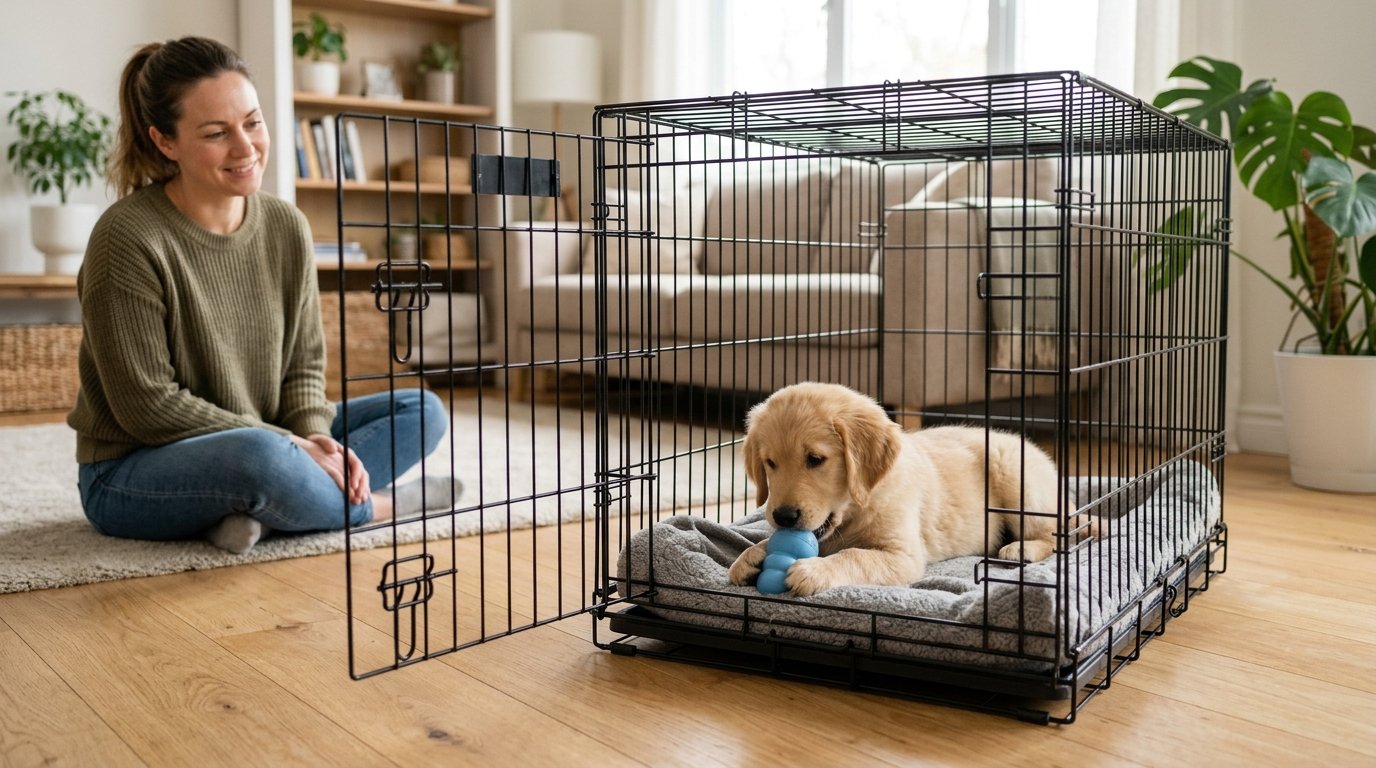
The most successful crate training is when the crate becomes a place your puppy wants to go into, rather than a place you force them into when something goes wrong.
That’s why games can be so helpful. Instead of having to keep asking a puppy to “go in the crate,” you can turn the crate into a short, predictable, reward-based game. Whether it’s a treat just inside the doorway, a toy found at the back, or a calm pause followed by a release, the same basic lesson can be taught: being in the crate makes good things happen.
The crucial difference is that crate games should promote comfort, not just test how long a puppy can be contained. This is consistent with current veterinary behavior recommendations of reward-based training and gradual increases in length.
Table of Contents
Before You Start: Make the Crate Easy to Win
Before you start playing crate training games, set up an environment that gives your pup a fair chance of success.
The crate should be big enough for the dog to stand up, turn around, lie down comfortably, and change position, but not so big that it becomes a place for the puppy to be kept for long periods just because he has not learned to settle.
Keep the crate door open during the first few games. Don’t drag or pull the puppy inside; let him explore it on his own terms.
It also helps to have small, easy-to-eat treats available. The reward should be close to the behavior you want to reinforce. A few pieces of kibble can work especially well when doing lots of repetitions, because you can use part of the puppy’s normal daily food allowance instead of adding lots of extra treats.
Most importantly, do not punish a dog by using the crate. The goal is to create a good association with the space.
A useful rule for every game
If your puppy willingly participates, keep going.
If they hesitate, back away from the difficulty.
If they show obvious distress, stop the exercise and reassess.
A successful crate-training session should leave the puppy comfortable enough to try again.
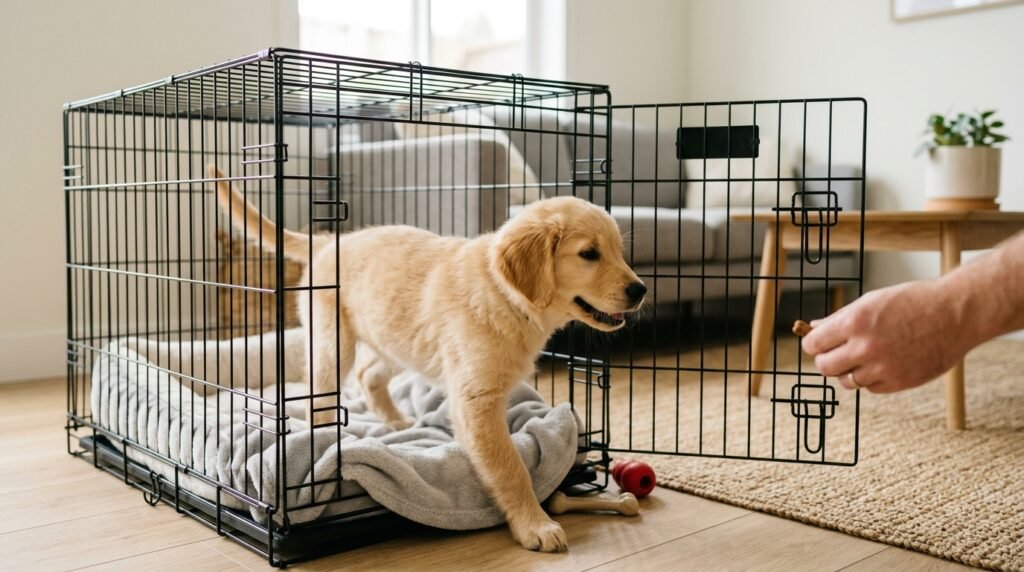
1. The Treat Trail
Best for: Puppies who are unsure about entering the crate.
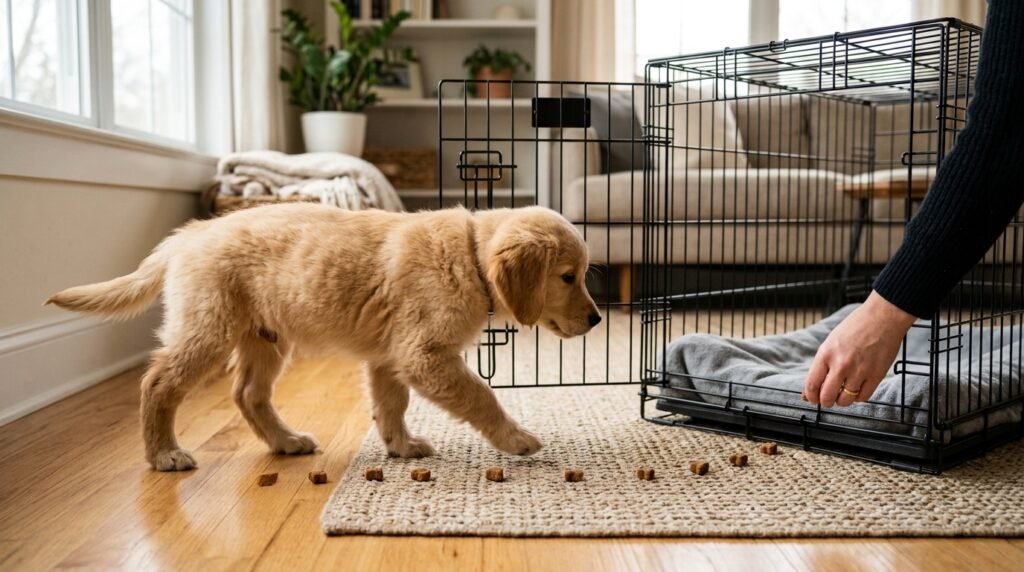
This is one of the simplest crate training games because it lets the puppy control how far they go.
How to play
- Leave the crate door completely open.
- Place a small treat near the entrance.
- When your puppy takes it comfortably, place the next treat slightly farther inside.
- Gradually move the treats toward the back of the crate.
- Let your puppy walk back out whenever they want.
- Repeat several times without closing the door.
The goal is not to get the puppy trapped inside. The goal is to make moving toward and into the crate rewarding.
If your puppy reaches a point where they stretch forward but will not enter, you have probably moved the reward too far too quickly. Put the next treat closer to the doorway and rebuild from there.
Why it works
The game breaks one intimidating behavior—walking into an enclosed space—into tiny, easy decisions. This gradual approach helps the puppy form positive associations instead of learning that entering the crate causes the door to suddenly close.
2. Find the Treasure
Best for: Puppies who already enter the crate but need more enthusiasm.
Turn the crate into a place where interesting discoveries occasionally happen.
How to play
With the door open, quietly place a small food reward just inside the crate while your puppy is looking elsewhere. Let them discover it rather than immediately pointing it out.
Once your puppy understands the game, vary the location:
- Near the entrance
- Just inside the crate
- Toward the back
- In a safe food puzzle or stuffed enrichment toy
Do not make every discovery difficult. Easy wins keep the game moving.
Why it works
Your puppy begins to investigate the crate voluntarily. That matters because voluntary behavior is different from simply complying after being physically guided inside.
This type of surprise reward is also consistent with crate-training guidance that recommends allowing dogs to discover rewards inside an open crate.
3. In-and-Out Game
Best for: Teaching voluntary crate entry.
This game looks almost too simple, but repetition is what makes it useful.
How to play
Stand near the crate with several small treats.
- Toss one treat just inside.
- Let your puppy enter and eat it.
- When they come back out, pause.
- Toss another treat inside.
- Repeat.
Do not immediately shut the door.
After several repetitions, your puppy may begin turning around and returning to the crate without waiting for the treat to land.
That is exactly what you want.
Make it more interesting
Occasionally give two or three treats in a row once your puppy is inside. On other repetitions, give just one.
This prevents the puppy from learning that every entry must produce the same predictable pattern.
4. Crate Fetch
Best for: Puppies who love toys and already feel comfortable around the crate.
This is one of the more interactive crate games for dogs.
Use a lightweight puppy-safe toy that your dog already enjoys.
How to play
Start by tossing the toy a short distance.
Gradually position the throw so that the puppy has to put their front feet inside the crate to retrieve it. Later, toss it farther toward the back.
Let the puppy bring the toy out again.
Repeat without closing the door.
Important safety point
Keep the game controlled. You do not want a puppy repeatedly crashing into the crate, slamming into the doorway, or becoming so excited that they lose interest in entering calmly.
The purpose is still comfortable crate entry, not athletic performance.
5. Dinner Inside
Best for: Puppies who are food motivated or need a slower, calmer crate activity.
Food can make crate training considerably easier because eating naturally gives the puppy something constructive to do while inside.
Start with the food bowl near the entrance.
As your puppy becomes comfortable, gradually move the bowl farther inside.
For some puppies, this progression can happen over several meals. For others, it may take longer.
There is no advantage to rushing it.
Why meals work well
A meal provides a longer positive experience than a single treat. Instead of entering the crate, grabbing one reward, and leaving, your puppy gets a reason to remain there comfortably for a little longer.
If your puppy refuses to eat once the bowl is moved deeper into the crate, simply move it back to the last position where they were comfortable.
6. The Calm Countdown
Best for: Puppies who enter the crate but immediately bounce back out.
Once your puppy is comfortable inside, begin reinforcing short periods of calm behavior.
How to play
Ask your puppy to enter or toss a treat inside.
When they settle, quietly count:
One… two… three.
Give a reward.
Repeat.
Over several sessions, gradually increase the interval:
- 3 seconds
- 5 seconds
- 8 seconds
- 10 seconds
- 15 seconds
There is no requirement to increase the duration every repetition.
In fact, mixing easy repetitions with slightly harder ones can help prevent the exercise from becoming predictable and frustrating.
What counts as calm?
Look for ordinary relaxed behavior:
- Standing quietly
- Sitting
- Lying down
- Sniffing
- Chewing an appropriate toy
- Resting their head
- Looking away from you rather than constantly demanding interaction
The goal is not rigid obedience. You are teaching the puppy that relaxing in the crate is rewarding.
7. Crate Cue Game
Best for: Puppies who already enter the crate willingly.
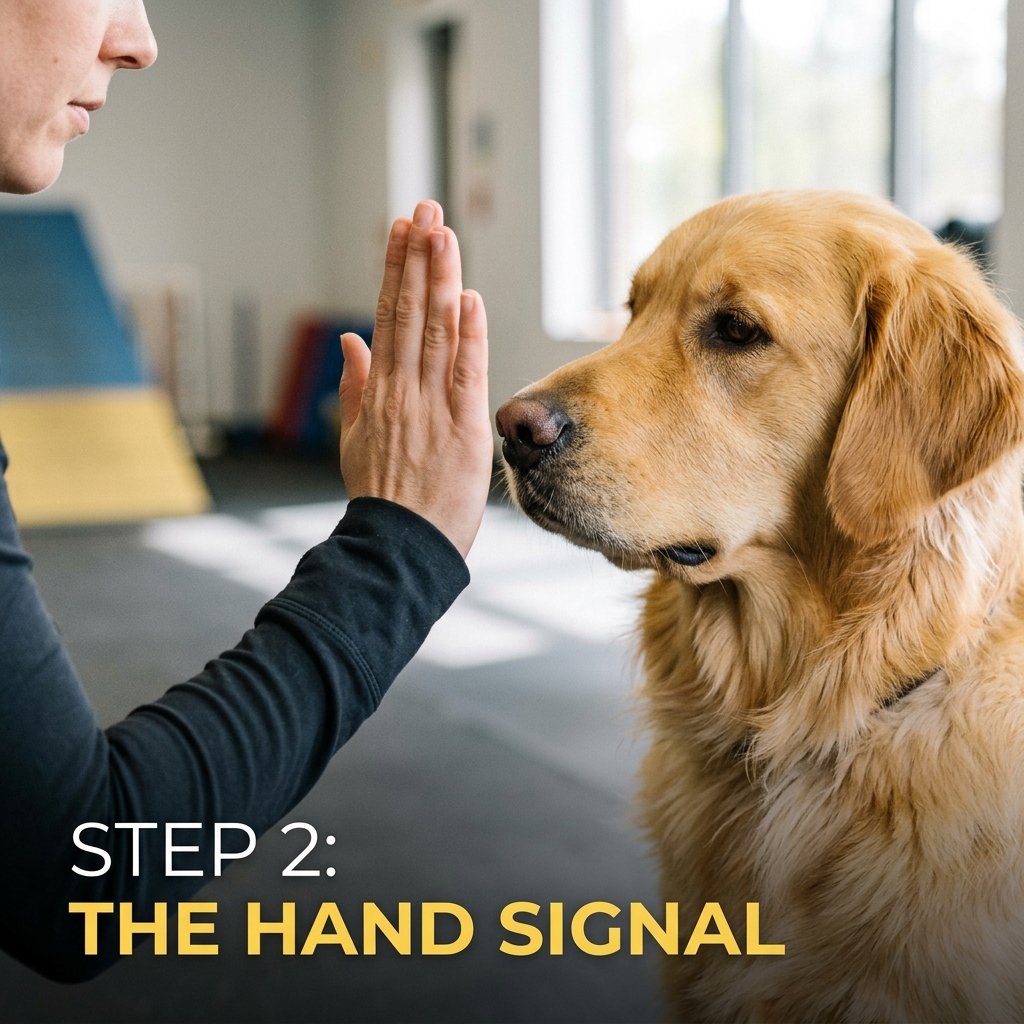
Once your puppy is confidently going inside, you can add a verbal cue such as “crate,” “kennel,” or “bed.”
How to play
Wait for a moment when you know your puppy is likely to enter.
Say the cue immediately before they go inside.
As soon as they enter, reward them.
After enough repetitions, the word begins to predict the behavior.
Eventually, you can say the cue before presenting the treat rather than using the treat to lure the puppy into the crate.
Avoid this common mistake
Do not repeatedly say “crate, crate, crate, crate” while your puppy ignores you.
A cue works best when it has a clear history of predicting a behavior that the dog already knows.
AKC likewise recommends introducing a crate cue after the dog is already reliably entering voluntarily.
8. Door Movement Game
Best for: Dogs who happily enter the crate but become nervous when the door moves.
This is where many owners progress too quickly.
Entering a crate comfortably does not automatically mean a puppy is ready for a closed door.
How to play
With your puppy inside:
- Move the door slightly.
- Stop.
- Reward your puppy.
- Open the door fully.
- Repeat.
Next time, move it a little farther.
Eventually, you can bring the door all the way closed for a brief moment, reward, and reopen it.
At first, the entire closed-door portion may last only a second.
Why go so slowly?
The sound and movement of a crate door can change the puppy’s emotional response immediately. Gradual exposure allows the puppy to learn that door movement predicts rewards rather than confinement or something frightening.
AKC recommends introducing door closure gradually and reinforcing the dog while inside.
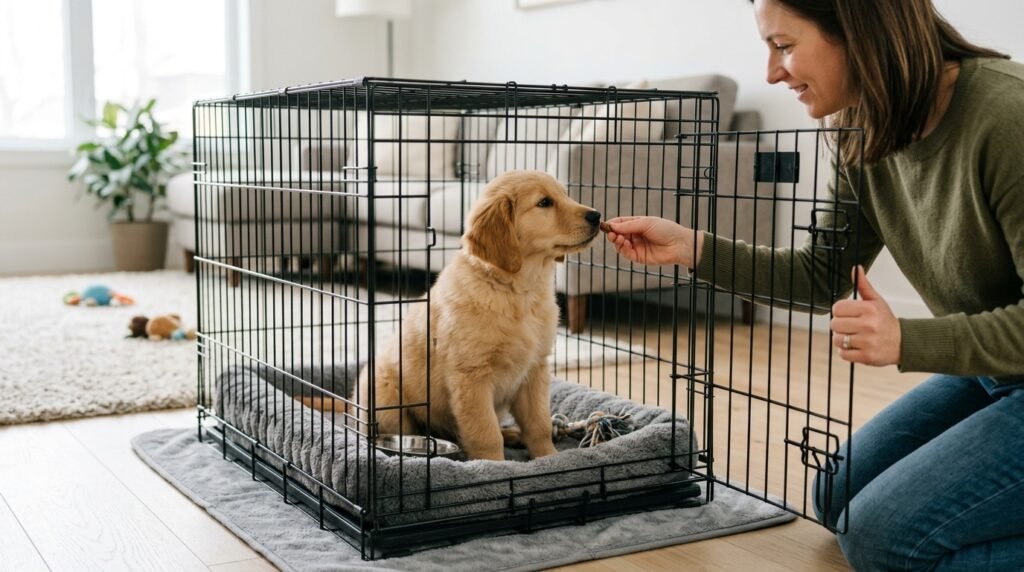
9. Distance Detective
Best for: Dogs who can relax briefly behind a closed door.
Once your puppy is comfortable with the door closed for short periods, introduce distance.
Start with something almost laughably easy.
Close the door.
Take one step away.
Immediately return and reward.
Repeat.
Then try two steps.
Later, walk several feet away.
Eventually, you can briefly disappear from sight.
The important training principle
Do not increase everything simultaneously.
For example, going from:
Door closed + 10 seconds + owner leaves the room
may be much harder than:
Door closed + 5 seconds + owner standing beside the crate.
Change one variable at a time whenever possible.
Duration, distance, and distraction are separate challenges.
AKC specifically recommends building duration and distance gradually rather than making every repetition progressively harder.
10. Surprise Release Game
Best for: Teaching your puppy that calm behavior—not barking or frantic scratching—leads to the next part of the game.
Place your puppy in the crate and give them an appropriate reward.
Wait for a brief period of calm.
Then quietly open the door.
Sometimes release them after a few seconds. Other times, wait slightly longer.
Keep the release calm rather than turning every opening into an explosive play session.
Why it helps
The puppy learns that crate time is predictable and that calm behavior is part of the routine.
But don’t interpret this as a rule that a puppy should simply be ignored if they are distressed. Vocalizing can have different causes, including needing to eliminate, discomfort, boredom, fear, or anxiety. The solution depends on the cause.
How to Know When to Make a Game Harder
The best time to increase difficulty is when your puppy is succeeding comfortably at the current level.
Signs that your puppy is ready for a small progression include:
- Entering the crate without hesitation
- Taking treats normally
- Relaxing inside
- Remaining comfortable when you move nearby
- Recovering quickly after small changes
- Choosing to enter without being lured every time
Signs that you have progressed too quickly include:
- Refusing normally attractive treats
- Repeatedly trying to leave
- Scratching or biting at the crate
- Escalating barking or whining
- Panting unrelated to heat or exercise
- Persistent frantic behavior
- Trying to escape
When that happens, don’t simply repeat the harder version until the puppy “gives in.”
Make the exercise easier.
Common Crate Training Mistakes
1. Closing the door too soon
A puppy that willingly walks into an open crate may not yet be comfortable with confinement.
Build the association first. Add the closed door gradually.
2. Using the crate as punishment
Sending a puppy to the crate because they did something wrong can undermine the very association you are trying to build.
The crate should remain a predictable, safe management space—not the canine equivalent of a punishment corner.
3. Increasing duration too quickly
Being able to remain inside for 30 seconds does not automatically mean the puppy is ready for 10 minutes.
Build duration in small increments and occasionally return to easy repetitions.
4. Making every repetition harder
If every game gets progressively more difficult, your puppy may start anticipating failure.
Mix easy repetitions with moderate ones.
5. Using treats as a permanent bribe
At first, food can guide and reinforce behavior.
Over time, however, the goal is for the cue and the behavior itself to become established. You can gradually reduce the dependence on visible food while continuing to reward good behavior.
6. Expecting the crate to solve separation anxiety
A crate is not automatically an appropriate solution for a dog experiencing serious separation-related distress.
Some dogs with separation anxiety may panic when confined and can injure themselves trying to escape. In those cases, professional behavioral guidance is more appropriate than simply increasing crate time.
What If Your Puppy Whines or Panics?
Whining should not automatically be interpreted as “bad behavior.”
First ask why the puppy is vocalizing.
Possible causes include:
- Needing a bathroom break
- Being uncomfortable
- Being overtired
- Wanting interaction
- Having been asked to stay inside too long
- Fear or anxiety
- Difficulty adjusting to the crate
A puppy that wakes in the night and cries may really have to go out. A puppy that is going to frantic sort of behavior in his escape behavior is another problem.
If your puppy is consistently distressed or panicked, don’t make the difficulty harder. The AKC suggests that dogs displaying extreme distress or possible signs of separation anxiety might need professional help rather than just being left to cry it out.
If your pet shows severe anxiety, aggression, self-injury, or ongoing distress due to confinement, discuss these issues with your veterinarian or a certified behavior professional.
How Often Should You Play Crate Training Games?
Short sessions are usually easier for puppies than long training marathons.
You might play one or two simple games for a few minutes, several times throughout the day. The exact amount should depend on the puppy’s age, temperament, previous experience, and ability to remain relaxed.
You do not need to complete all 10 games in one session.
A better progression is:
Explore → enter voluntarily → stay briefly → tolerate door movement → tolerate a closed door → build duration → add distance.
If your puppy struggles at one stage, return to the previous successful stage.
Consistency matters more than exhausting the puppy with repetitions.
FAQ
What are the best dog crate training games for puppies?
The most useful games are simple reward games that motivate voluntary entry into the crate and promote calmness. Treat trails, treasure hunts, in-out games, meal feeding, gradual door movement, and short-distance games can all be used to build positive associations.
How do you make crate training fun?
Make the crate predict things your puppy values, such as small treats, meals, safe toys, enrichment, and calm attention. Keep early sessions easy and allow the puppy to enter voluntarily rather than forcing them inside.
Can you play games inside a dog crate?
Yes, as long as the game is suitable for the crate and does not promote unsafe jumping, crashing, chewing on the crate, or erratic movement. Food-search games, calm chewing, and short reward exercises are generally more suitable than high-energy physical play.
Should I close the crate door during crate games?
When your pup is comfortable going in willingly, you can begin to introduce the closed door, but start with very short periods of time. Don’t just suddenly lock the puppy inside for a long period; gradually increase the duration.
How long should puppy crate training sessions last?
There is no single correct session length for every puppy. Short, successful sessions are often easier to manage than long sessions, and difficulty should increase gradually according to the individual puppy’s comfort.
What if my puppy refuses to enter the crate?
Simplify the exercise. Leave the door ajar, place the rewards nearer to the entrance, and allow your puppy to explore in his own good time. Avoid forcing or pulling your puppy into the crate, as this can create a negative association.
Should I use treats for crate training?
Treats are a practical way to reinforce voluntary entry and calm behavior, particularly during the early stages. You can also use meals, toys, and other forms of appropriate reinforcement depending on what your puppy finds rewarding.
Is crate training good for every dog?
Crate training can be a useful life skill, but not all dogs respond the same way to confinement. If a dog is having major panic or separation-related issues, it may need a different management system and professional behavioral advice, not just more crate time.
Can crate training help with potty training?
A properly managed crate can support a puppy’s potty-training routine because it can limit opportunities for unsupervised accidents and create a predictable schedule. It should not be used as a substitute for regular bathroom breaks or appropriate supervision.
Should the crate be used as punishment?
No. Using the crate as punishment can undermine the positive association you are trying to establish. Reward-based training guidance recommends keeping the crate associated with safety, rest, food, enrichment, and other positive experiences.
Conclusion
The best crate games aren’t really about crating a puppy. They’re about training your puppy that selecting the crate, settling in, and being calm can lead to good things.
Start with the simplest games: treat trails, treasure hunts, and in-and-out repetitions. As your puppy becomes comfortable, slowly introduce the door, length of time, and distance.
One last tip: Finish a session while your puppy is still winning. It is usually better to leave your puppy wanting to play another easy game tomorrow than to squeeze in one difficult repetition today.
About the Training Approach
This guide uses reward-based training and gradual progression rather than punishment or forced confinement. Current AVSAB guidance recommends reward-based methods for canine training, while AKC crate-training guidance emphasizes voluntary entry, positive associations, and gradual increases in duration and distance.

Discussion 0 comments
Share your thoughts — every perspective adds value.