


More than 60% of new dog owners give up on crate training in the first two weeks. It’s not that crate training doesn’t work; it’s that they were misinformed from day one.
Much of what people believe about crating a dog at night is based on old advice, well-meaning friends, or guilt. And those beliefs are eating away at the process before it can even get started.
In this article, we’re going to bust the most common myths about crate training at night and replace each myth with what actually works.
The Truth About Crate Training at Night
Crate training is not a punishment. It’s not cruel. And it’s not a shortcut for lazy owners.
When done correctly, a crate becomes the one place in your home where your dog feels genuinely safe — a den, not a jail. But getting there requires unlearning several things first.
Myth #1: “Letting Them Cry It Out Will Teach Independence”
The myth: If you ignore the crying long enough, the dog learns to self-soothe.
The truth: Puppies and dogs are social animals. Long periods of crying with no response don’t create independence – they create anxiety. On the first night, if you leave a puppy to cry for hours, they’re not learning that the crate is safe. It is discovering that cries of distress are not answered.
According to studies by the American Veterinary Medical Association (AVMA), early negative experiences with isolation can lead to long-term separation anxiety in dogs.
What to do instead:
- Respond calmly to sustained crying — a quiet word or placing your hand near the crate
- Distinguish between protest whining (short, intermittent) and genuine distress (escalating, continuous)
- Respond to distress. Let protest settle on its own
Expert Tip: The goal isn’t to ignore your dog into silence. It’s to help them feel safe enough that silence happens naturally.
Myth #2: “Bigger Crate = More Comfortable = Better Sleep”
The myth: A larger crate gives the dog more room to get comfortable.
The reality: Dogs instinctively avoid soiling the area where they sleep. A correctly sized crate uses this instinct to support potty training. A crate that’s too large gives the dog room to sleep in one corner and use the bathroom in another — eliminating that instinct entirely.
The right size:
- Enough room to stand up fully
- Enough room to turn around
- Enough room to lie stretched out
Nothing more. If you buy a large crate for a puppy to “grow into,” use a divider panel to reduce the space until they’re fully grown.
Myth #3: “You Should Never Respond to Nighttime Crying”
The myth: Any response to crying reinforces the behavior and makes it worse.
The reality: This rule, applied without nuance, causes real harm. There are legitimate reasons a dog cries at night:
- They need a bathroom break
- They’re in pain or discomfort
- They’re genuinely panicked in a new environment
- The crate is positioned in a way that feels isolating
Ignoring all crying without checking first means you might be leaving a puppy to soil their crate for hours, or missing an early sign of illness.
The correct approach:
- Wait 1-2 minutes before responding
- Do a calm, low-key check — no excitement, no eye contact
- Rule out bathroom need first
- If everything is fine, settle them quietly and step back
Myth #4: “Crate Training Works the Same for Every Dog”
The myth: Follow the standard steps and it works.
The reality: Breed, age, background, and temperament all affect how a dog responds to nighttime crating.
| Dog Type | What Changes |
|---|---|
| Young puppies (under 12 weeks) | Need bathroom breaks every 2-3 hours |
| Rescue dogs | May have crate trauma — need slower introduction |
| High-anxiety breeds | Need more transition time and reassurance |
| Adult dogs new to crating | Need daytime crate exposure before nighttime use |
| Brachycephalic breeds (Bulldogs, Pugs) | Need extra airflow — avoid enclosed fabric crates |
There is no single timeline. Some dogs settle in three nights. Others take three weeks. Adjust your expectations to the dog in front of you, not the average dog in a training guide.
Myth #5: “The Crate Should Be in a Separate Room So They Learn to Be Alone”
The myth: Putting the crate in your room creates dependency.
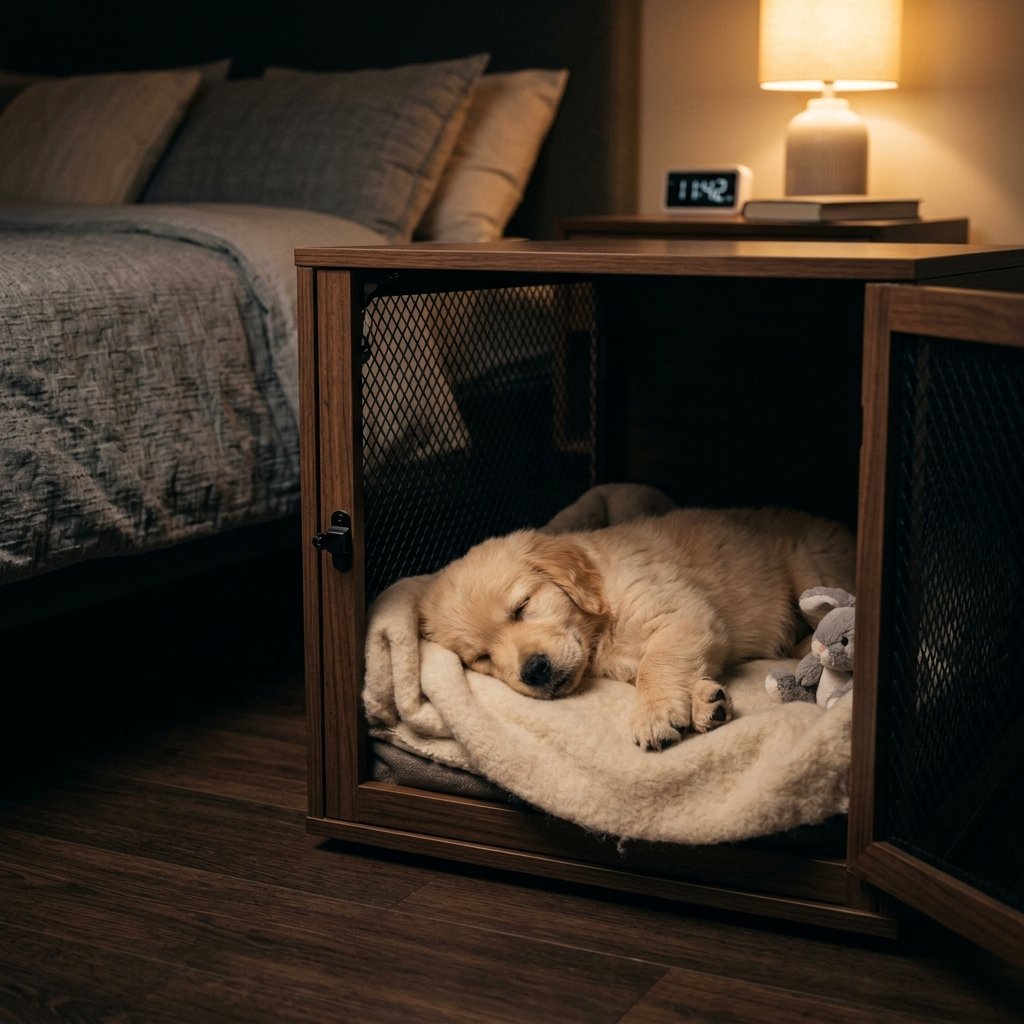
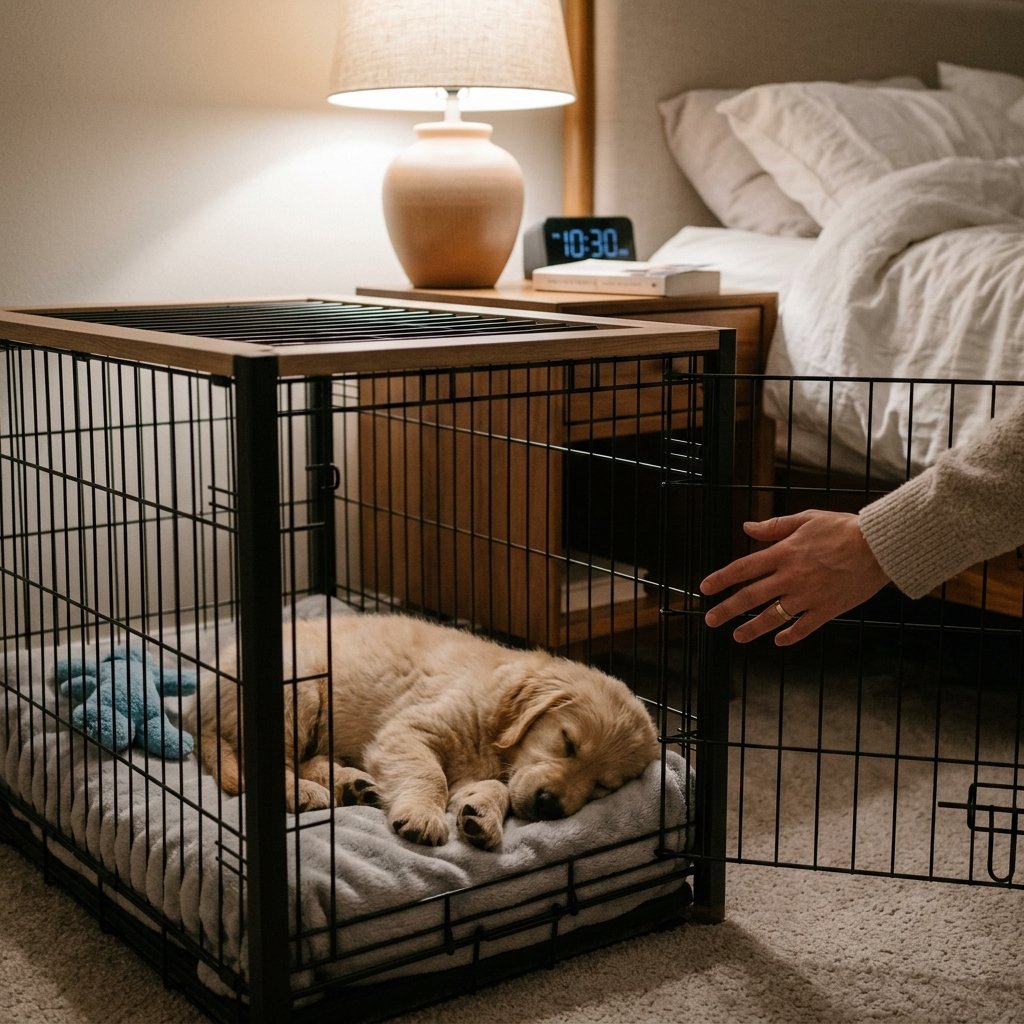
The reality: Putting the crate in your bedroom — at least for the first few weeks — is one of the most effective things you can do for nighttime crate training success.
Here’s why it works:
- Your scent and breathing sounds calm their nervous system
- You can hear when they actually need a bathroom break
- They learn the crate is safe without the added stress of isolation
- It builds the foundation of trust faster
You can gradually move the crate further from your bed, then to a hallway, then to your preferred location once they’re sleeping through the night reliably. Rushing this process by starting in a separate room often makes the training take longer, not shorter.
Myth #6: “Once They Sleep Through the Night, You’re Done”
The myth: Sleeping through the night = crate training complete.
The reality: Nighttime success doesn’t automatically mean the dog is comfortable in the crate during the day, or during longer stretches, or when your routine changes.
True crate comfort means:
- The dog enters the crate willingly without being prompted
- The dog shows no distress signs when the door closes
- The dog can settle in the crate while you’re home
- The dog doesn’t escalate into destructive anxiety when left
If your dog only tolerates the crate at night because they’re tired, that’s not crate training — that’s exhaustion. Keep reinforcing positive associations with the crate during daytime as well.
Common mistakes at this stage:
- Stopping treats and praise once nighttime improves
- Using the crate only at night — not for daytime naps or rest
- Leaving the dog for long stretches before they’re truly ready
Myth #7: “Crate Training Is Cruel If the Dog Cries”
The myth: A dog crying in the crate is proof the crate is harmful.
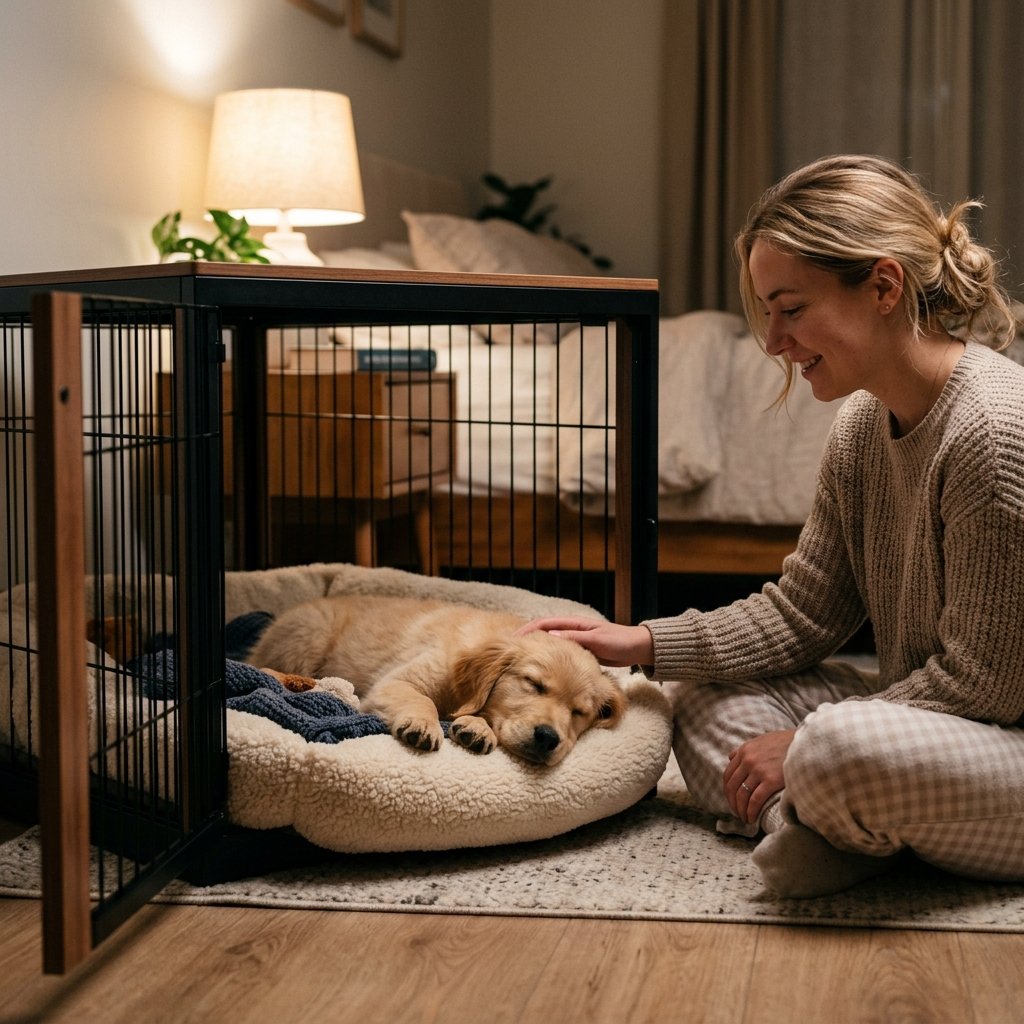
The reality: Crying during crate training is normal. It doesn’t mean the dog is suffering permanently — it means they’re adjusting. The same way a child cries on the first day of school without that being evidence that school is cruel.
What would actually make crate training cruel:
- Leaving a dog crated for 8-10 hours without a break
- Using the crate as punishment after bad behavior
- Forcing the dog in without any positive introduction
- Ignoring genuine distress signs (panting, drooling, frantic scratching)
Crying during a proper crate training process — where the dog is safe, comfortable, and has everything they need — typically fades within a few nights. That is not cruelty. That is adjustment.
Expert Tip: If crying continues past 2 weeks with no improvement despite consistent training, consult your veterinarian. Persistent distress can sometimes indicate underlying anxiety that benefits from professional support.
Common Mistakes to Avoid at Night
Using the crate as punishment:
Even once. The moment the crate becomes associated with negative consequences, the training resets.
Skipping the pre-bedtime potty trip:
The last thing before the crate is outside. Always. This single habit prevents most nighttime accidents.
Inconsistent placement:
Moving the crate between rooms night to night disrupts the routine. Dogs settle faster with predictability.
Making the midnight bathroom trip exciting:
Lights on, talking, playing — these signal to the dog that 2 AM is activity time. Keep it dark, quiet, and boring.
Putting bedding in the crate before the dog is ready:
Some puppies will shred or chew bedding, which creates a hazard. Start with a thin mat and build up once they’ve shown they won’t destroy it.
FAQ
Q: How long should crate training at night take?
Most dogs show significant improvement within 5-7 nights when training is consistent. Full comfort with the crate, including settling quickly and sleeping through the night without accidents, typically takes 2-4 weeks depending on age and temperament.
Q: Should I cover the crate at night?
Covering three sides of the crate with a blanket can create a den-like feeling that many dogs find calming. Leave the front uncovered for airflow. Not all dogs respond the same — watch your dog’s behavior to see if it helps or increases anxiety.
Q: My dog only cries when I leave the room. Is that separation anxiety?
It could be the first signs of it, or it could just be typical attachment behavior in a young dog that is still adjusting. Try putting the crate in your bedroom for a couple of weeks. If the behavior is extreme drooling, frantic escape attempts, inability to settle even when you’re there – see a veterinarian or certified dog behaviorist.
Q: Can I use a playpen instead of a crate at night?
A playpen provides more room but loses the den effect that makes crates so effective for sleep and potty training. Some owners use both, a crate inside a playpen, so the dog has a place to sleep and a little more room for overnight comfort. This can work well for puppies who are struggling with the confined crate.
Q: What if my dog was never crate trained as a puppy?
Adult dogs can absolutely learn to use a crate. The process is the same but may take longer since they have established habits. Expect 3-6 weeks for a relaxed adult dog, and longer if there’s any history of anxiety or confinement stress.
Quick Summary Table
| What People Believe | What Actually Works |
|---|---|
| Let them cry it out completely | Respond calmly to distress, let protest settle |
| Bigger crate is more comfortable | Right-sized crate supports potty training instincts |
| Separate room builds independence | Bedroom placement builds safety and trust faster |
| Sleeping through the night = done | Continue daytime crate reinforcement too |
| Any crying means it’s cruel | Crying during adjustment is normal and temporary |
| Same method works for every dog | Adjust timeline and approach to your specific dog |
| Never respond to nighttime crying | Rule out bathroom need before ignoring |


Discussion 0 comments
Share your thoughts — every perspective adds value.