

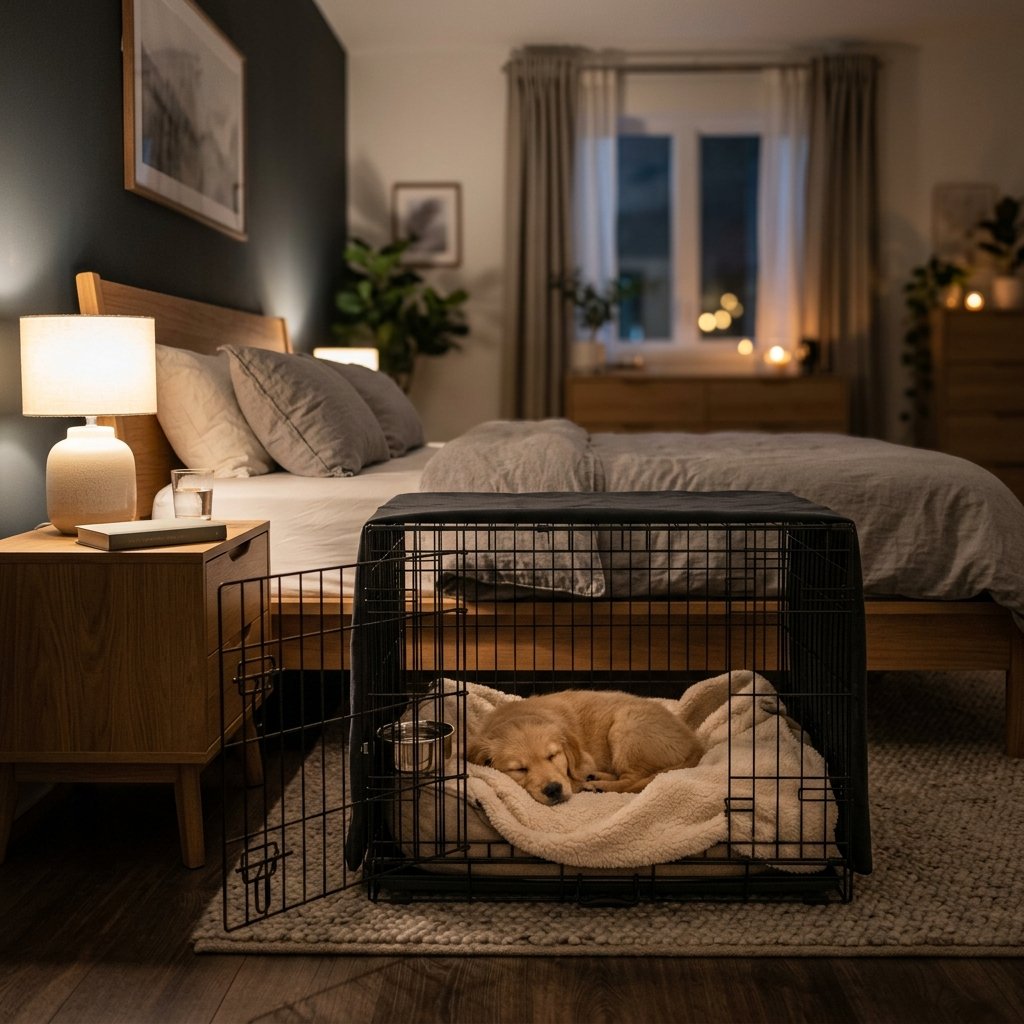
When a dog sleeps in a crate at night, it should look relaxed, not just stuck in there. The idea is that the crate becomes a safe place to sleep, where your dog can relax, rest, and feel safe.
That difference is a big deal. Closing a puppy in a crate and waiting for him to get used to it is one thing, but teaching him that the crate is a comfortable place to sleep is something else.
Crate training, when done correctly, involves slow acclimation, positive associations, a crate that is the right size, regular opportunities to relieve itself, and a bedtime routine that lets the dog know it is time to settle down for the day. Veterinary behavior advice also recommends looking for the difference between short protest and real distress.
Is It Okay for a Dog to Sleep in a Crate at Night?
Yes. A dog can sleep in a crate at night when the crate is appropriately sized and the dog has been introduced to it positively.
The crate should allow the dog to stand comfortably, turn around, lie down, and stretch out. It should not be used as punishment or as a substitute for exercise, attention, bathroom breaks, or normal interaction with the household.
For many dogs, nighttime is actually one of the easier times to introduce longer crate periods because they are naturally ready to sleep.
The important question is not simply:
“Can my dog stay inside the crate all night?”
It is:
“Can my dog comfortably relax and sleep there without becoming distressed or needing a bathroom break?”
Young puppies require particularly careful management because they may not yet have enough bladder control to sleep through the entire night.
Why Nighttime Crate Training Can Be Useful
A well-established crate routine can provide several practical benefits.
It Creates a Predictable Sleeping Area
Dogs often settle more easily when bedtime follows a consistent pattern.
When the same sequence happens each evening—activity winds down, the dog goes outside, enters the crate, receives a small reward, and the lights become quiet—the environmental cues begin to predict sleep.
It Helps With Puppy House Training
Dogs generally prefer not to eliminate where they sleep. An appropriately sized crate can therefore support a house-training routine, provided the puppy is taken outside frequently enough.
A crate cannot increase a puppy’s physical bladder capacity, though. Leaving a puppy confined longer than they can reasonably hold their bladder can lead to accidents rather than better house training.
It Can Prevent Unsafe Nighttime Exploring
Young dogs may chew electrical cables, swallow objects, climb furniture, or investigate things they should not when unsupervised.
A properly introduced crate provides controlled overnight confinement while the dog is still learning household boundaries.
It Can Become a Resting Space
Some crate-trained dogs eventually choose to enter their crate voluntarily when they want uninterrupted rest.
VCA notes that careful crate training can help dogs learn to associate the space with resting and sleeping rather than isolation.
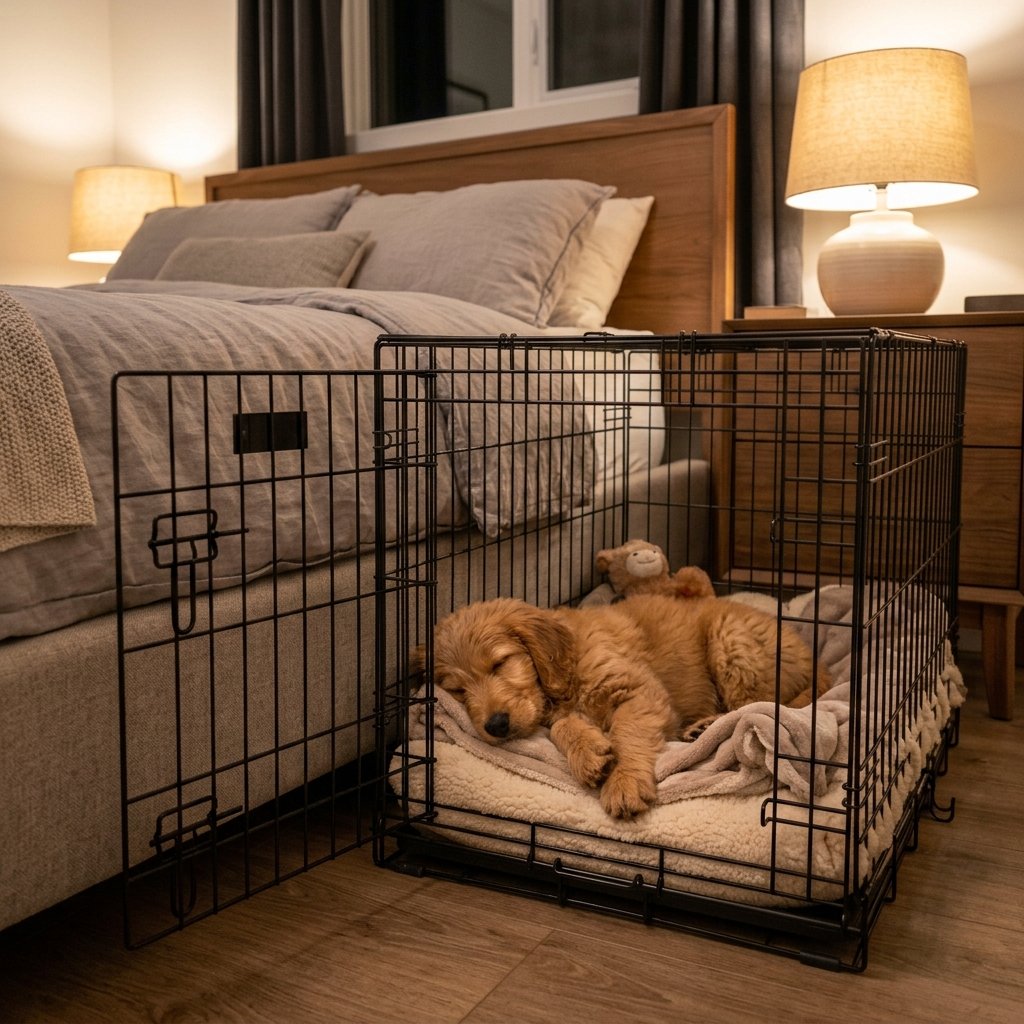
Where Should Your Dog’s Crate Be at Night?
For a new puppy, placing the crate inside your bedroom or close to where you sleep is often a practical starting point.
There are two reasons.
First, puppies are social animals and moving from sleeping beside littermates to suddenly sleeping alone can be a significant change.
Second, keeping the crate nearby makes it easier to hear when a young puppy wakes because they genuinely need to eliminate.
The Humane Society recommends initially keeping a nighttime crate nearby and gradually moving it to your preferred location once the dog is comfortably sleeping through the night.
The crate does not necessarily have to remain beside your bed permanently.
Once your dog is settling reliably, you can move it gradually:
Bedroom → bedroom doorway → hallway → preferred sleeping location
Moving it a short distance every few nights is usually less disruptive than suddenly relocating the crate to another part of the home.
How to Set Up a Crate for Sleeping at Night
Comfort matters, but more bedding and accessories do not automatically create a better crate.
Choose the Correct Crate Size
Your dog should be able to:
- Stand without crouching
- Turn around easily
- Lie comfortably
- Stretch out
For puppies expected to grow substantially, a full-size crate with a divider can be useful. The divider allows you to increase the usable space as your puppy grows.
A crate that is unnecessarily enormous can also make early house training more difficult because some puppies may sleep at one end and eliminate at the other.
Add Appropriate Bedding
If your dog does not chew or destroy bedding, a washable crate mat or comfortable blanket can create a softer sleeping surface.
A puppy that regularly shreds and swallows fabric requires a safer setup. The priority is not making the crate look cozy—it is ensuring that anything left inside is safe for that individual dog.
Keep the Environment Comfortable
Place the crate somewhere that is:
- Well ventilated
- Away from extreme heat or cold
- Away from constant nighttime traffic
- Quiet enough for sleep
- Close enough initially that a puppy does not feel completely isolated
Some dogs settle better when part of a wire crate is covered. If you use a cover, maintain good ventilation and monitor the temperature inside.
How to Get a Dog Sleeping in a Crate at Night
Nighttime crate success usually begins before bedtime.
1. Build Positive Crate Associations During the Day
Do not make bedtime the first time your dog encounters the crate.
Allow them to explore it with the door open.
You can occasionally place treats inside, feed meals near or in the crate, or provide an appropriate food toy while your dog relaxes there.
VCA recommends beginning with the door open and gradually progressing to closing it while the dog is calmly occupied, then slowly increasing the amount of time the dog remains inside.
The important principle is gradual progression.
You want the dog thinking:
“This is where calm things happen.”
Not:
“Every time I enter this box, everyone disappears.”
2. Give Your Dog Appropriate Evening Activity
A dog that has spent the entire evening sleeping may understandably have trouble settling at bedtime.
Provide age-appropriate:
- Exercise
- Training
- Sniffing
- Play
- Social interaction
Avoid turning the final minutes before bedtime into an intense exercise session, though. The goal is a pleasantly tired dog, not an overstimulated one.
3. Take Your Dog Outside Before Bed
Give your dog a genuine opportunity to eliminate shortly before entering the crate.
Do not rush the bathroom trip and assume that walking outside for 30 seconds means the puppy has emptied their bladder.
A calm toilet break immediately before bed reduces one major reason for nighttime waking.
4. Keep the Bedtime Routine Calm
Bedtime does not need to become an elaborate ceremony.
Use your normal crate cue, allow the dog to enter, reward calm entry, and reduce stimulation.
Keep your voice and movements relaxed.
Consistency is more useful than excitement.
5. Turn Nighttime Into “Boring Time”
If your puppy wakes for a legitimate bathroom break, take them outside calmly.
Avoid:
- Games
- Excited talking
- Wandering around the house
- Long cuddle sessions
- Turning on every light
Allow the puppy to eliminate, quietly acknowledge successful toileting, and return them to bed.
This teaches an important distinction:
Daytime waking = activity
Nighttime waking = bathroom, then sleep
Veterinary behavior guidance specifically recommends calm, brief nighttime elimination trips so puppies do not learn that waking the household produces playtime.
What Should You Do If Your Dog Cries in the Crate at Night?
This is one of the most misunderstood parts of crate training.
Not every whine means the same thing.
A puppy might vocalize because they:
- Need to urinate or defecate
- Are uncomfortable
- Are frightened by being alone
- Have not yet learned how to settle
- Want attention
- Are frustrated about confinement
- Are experiencing genuine distress
Brief Fussing
A dog may whine briefly, reposition themselves, paw lightly at the door, and then settle.
If the behavior remains mild and decreases rather than escalates, giving the dog a short opportunity to settle can be reasonable.
Waking After Sleeping
A puppy that has been sleeping quietly for several hours and suddenly wakes, becomes restless, and vocalizes may need to eliminate.
Take them outside calmly, then return them to the crate.
Escalating Distress
Persistent screaming, heavy panting when the room is not hot, excessive salivation, frantic escape attempts, repeatedly throwing the body against the crate, or an inability to settle deserves a different response.
This should not simply be treated as “bad behavior.”
VCA advises seeking veterinary or veterinary-behavior guidance when a dog shows persistent distress such as excessive vocalization, salivation, escape attempts, or an inability to settle during confinement.
Should You Ignore a Puppy Crying in a Crate?
Not automatically.
The commonly repeated instruction to “ignore all crying” is too simplistic.
First determine whether the puppy reasonably needs the bathroom or is showing escalating distress.
If you know the puppy has recently eliminated, is physically comfortable, and gives a brief mild protest before settling, you do not necessarily need to open the crate immediately.
But leaving a frightened puppy to panic for an extended period does not teach calm crate behavior.
The objective is settling, not exhaustion.
How Long Can a Puppy Sleep in a Crate at Night?
There is no single number that applies to every puppy.
Age matters, but so do:
- Individual development
- Body size
- Drinking and feeding schedule
- Health
- House-training progress
- Previous routine
Very young puppies commonly need one or more nighttime bathroom trips.
VCA’s puppy guidance, for example, notes that a two-month-old puppy may require elimination opportunities around every two hours overnight, while a three-month-old puppy may need them roughly every three hours. It also emphasizes substantial individual variation.
Treat age-based numbers as planning guidance rather than a guarantee that your particular puppy can hold their bladder that long.
If a puppy repeatedly has overnight crate accidents, shortening the interval between bathroom trips is more useful than assuming the puppy is being stubborn.
Puppy vs. Adult Dog Sleeping in a Crate at Night
The basic training principles are similar, but the challenges are different.
| Puppy | Adult Dog |
|---|---|
| Often needs nighttime | May comfortably sleep through the night |
| Usually adapting | May already have |
| Bladder control is still developing | Toile |
| Often needs crate | Location may be more |
| Requires gradual independence training | May need gradual crate conditioning if never trained |
An adult dog that has never used a crate should still receive gradual training.
Age does not automatically mean the dog understands confinement.
Common Nighttime Crate Training Mistakes
Using the Crate Only When You Leave
If entering the crate always predicts separation, the dog may develop a negative association with it.
Include occasional crate naps or quiet periods while you are home.
Putting the Dog Straight Into the Crate With No Training
Comfort with confinement is a learned behavior.
Start with short, successful sessions and gradually increase the duration.
Using the Crate as Punishment
Sending a dog angrily into the crate after unwanted behavior undermines the association you are trying to build.
The crate should predict rest and safety rather than conflict. Both AKC and veterinary guidance advise against using a crate as punishment.
Ignoring Genuine Bathroom Needs
Young puppies cannot simply decide to develop adult-level bladder control.
If your puppy consistently wakes at a similar time and immediately eliminates when taken outside, schedule a bathroom break shortly before that point.
Making Nighttime Potty Trips Exciting
A 2 a.m. toilet break should not turn into a 20-minute play session.
Keep it functional and quiet.
Moving Too Quickly
If your puppy can remain calmly crated for ten minutes, that does not necessarily mean they are ready for eight uninterrupted hours.
Build duration gradually.
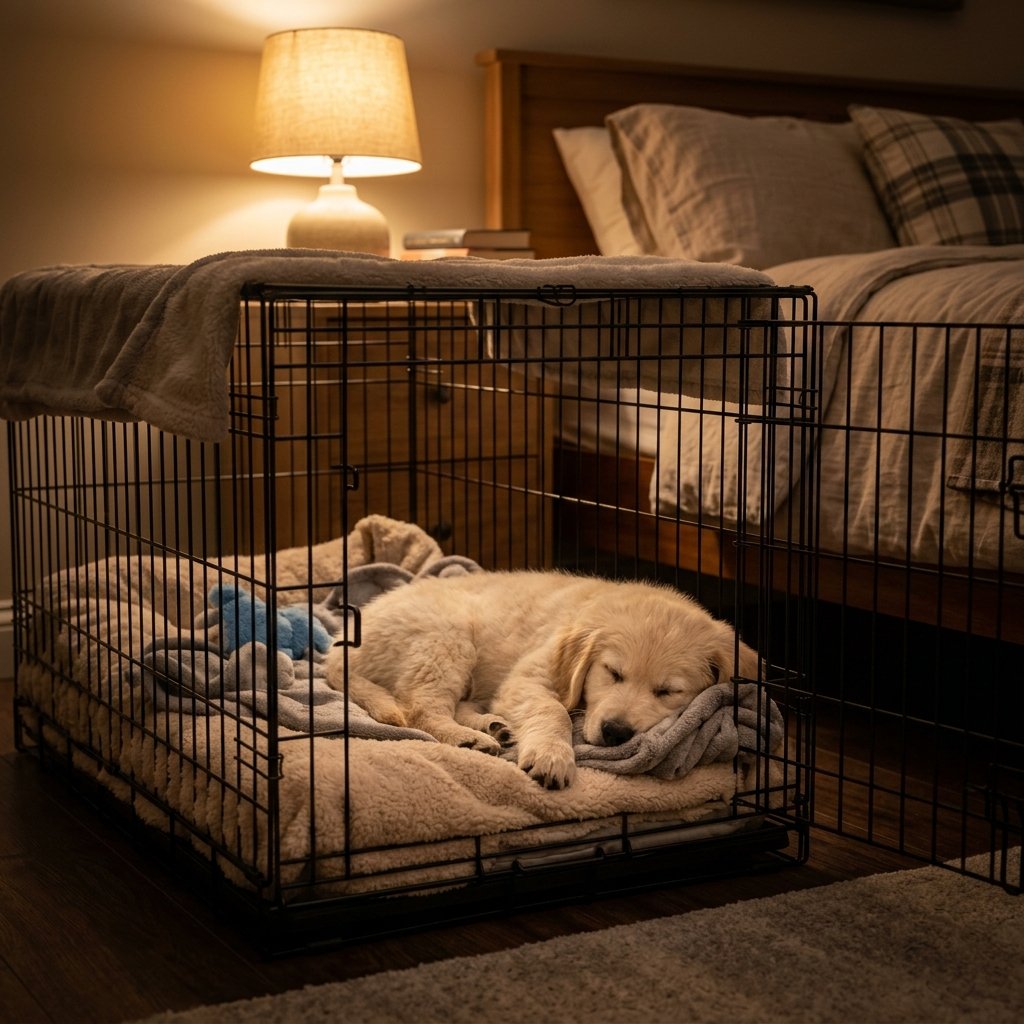
What If Your Dog Suddenly Stops Sleeping in the Crate?
A sudden behavioral change deserves attention, especially in a dog that previously slept comfortably.
Consider what changed.
Possibilities include:
- The room becoming hotter or colder
- A new source of noise
- Bedding becoming uncomfortable
- Changes in feeding or drinking times
- Increased nighttime bathroom needs
- A frightening event involving the crate
- Pain or illness
- Changes in the household
If the change is unexplained, persistent, or accompanied by symptoms such as vomiting, diarrhea, increased thirst, frequent urination, pain, restlessness, appetite changes, or unusual behavior, contact your veterinarian.
Training should not be used to mask a potential medical problem.
When a Crate May Not Be the Right Sleeping Setup
Crates work well for many dogs, but they are not appropriate for every individual.
Some dogs experience significant confinement distress.
A dog that repeatedly tries to break out can injure their:
- Teeth
- Nails
- Paws
- Face
In such situations, simply buying a stronger crate may address containment without addressing the dog’s distress.
A secure exercise pen, gated dog-proof room, or another management setup may sometimes be more appropriate while professional guidance is sought.
Crating is also not a treatment for separation anxiety. The Humane Society notes that dogs with separation anxiety may injure themselves attempting to escape and that the underlying anxiety requires behavioral treatment rather than simply tighter confinement.
Frequently Asked Questions
Is it good for a dog to sleep in a crate at night?
Yes, a dog can comfortably sleep in a crate at night when the crate is appropriately sized and has been introduced positively. The dog should be able to stand, turn around, stretch, and rest normally, and the crate should not be used as punishment.
Should I put my puppy’s crate in my bedroom?
Keeping a new puppy’s crate in or near your bedroom can make nighttime training easier. Your presence may help the puppy settle, and you can hear when they wake for a bathroom break. The crate can gradually be moved later if you want the dog to sleep elsewhere.
Should I cover my dog’s crate at night?
Some dogs relax more easily with part of the crate covered because it reduces visual stimulation. Other dogs prefer an uncovered crate. If you use a cover, keep ventilation adequate and make sure the crate does not become too warm.
Should I ignore my dog whining in the crate at night?
Brief mild whining may stop as a dog learns to settle, but persistent or escalating distress should not simply be ignored. A puppy that wakes after sleeping may also need a bathroom break. Frantic escape attempts, heavy salivation, or an inability to settle warrant professional guidance.
How do I get my dog to stop crying in the crate at night?
Help your dog develop positive crate associations during the day, provide appropriate evening activity, offer a bathroom break immediately before bed, and keep the crate near you during early training. Progress gradually rather than expecting a dog unfamiliar with confinement to immediately tolerate an entire night.
Can a puppy sleep in a crate all night without a potty break?
Very young puppies frequently cannot sleep through an entire night without eliminating. Their ability to do so generally improves as they mature, but individual development varies. Schedule nighttime bathroom trips according to your puppy’s age and actual toileting pattern rather than expecting them to hold it beyond their ability.
What should I put in my dog’s crate at night?
An appropriate crate setup may include safe, washable bedding if your dog does not chew or swallow it. Anything left in the crate should be safe for that particular dog when unsupervised.
When should I stop using a crate at night?
There is no required age for stopping nighttime crate use. Some dogs continue sleeping voluntarily in an open crate for years, while others transition to a dog bed once they are reliably house-trained, safe when unsupervised, and comfortable sleeping outside the crate.
Final Thoughts
Successful dog sleeping in crate at night training is less about keeping a dog confined and more about teaching them how to settle.
Start with a correctly sized crate, create positive associations during the day, provide an appropriate bedtime bathroom break, and build duration gradually. For puppies, expect nighttime needs to change as they mature.
Most importantly, pay attention to what your dog is communicating. A few minutes of mild fussing is different from sustained panic. Good crate training produces a dog that can relax—not simply a dog that has stopped trying to get out.


Discussion 0 comments
Share your thoughts — every perspective adds value.