

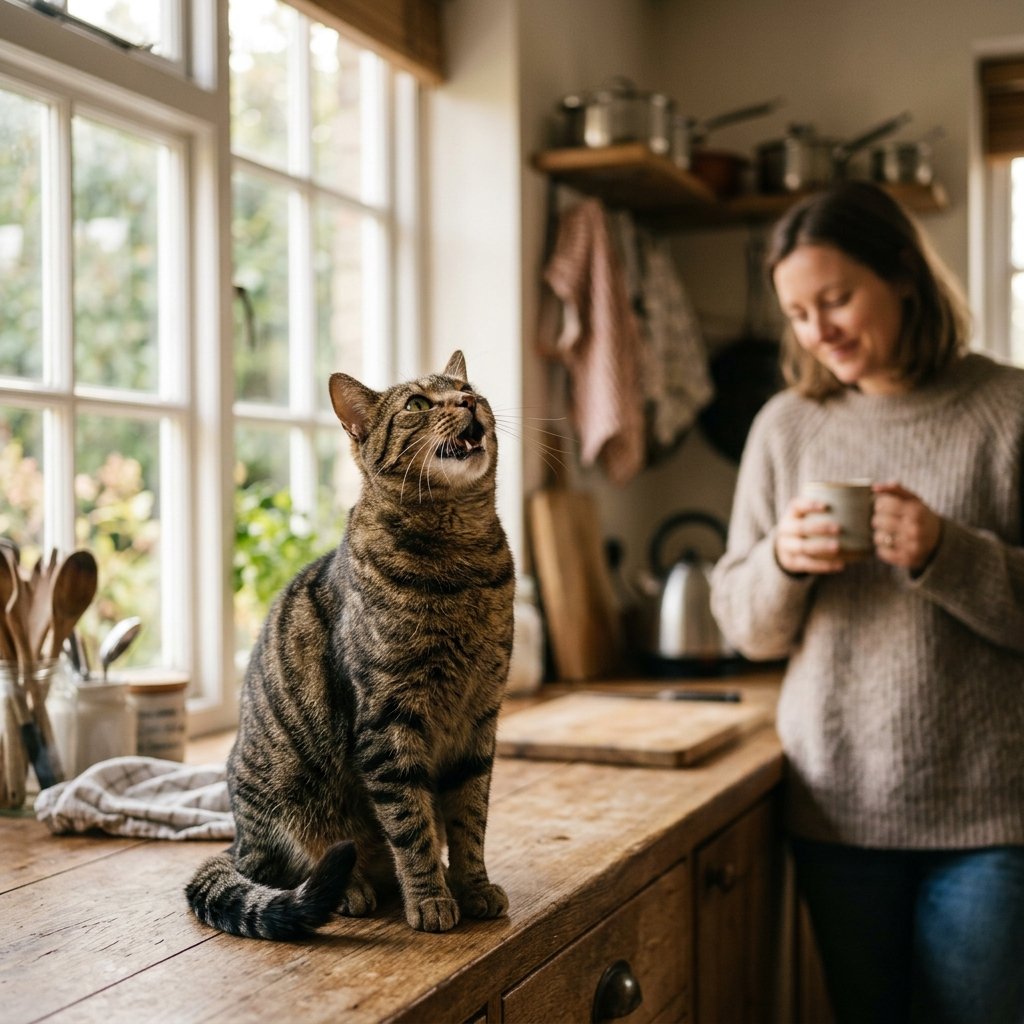
The general consensus is that a constantly meowing cat is just being dramatic, or that it’s “just the way cats are.” Some think it means the cat is friendly or happy. Here’s the thing: adult cats actually don’t meow at each other. They developed that behavior almost exclusively to communicate with humans.
So every time your cat meows at you, it is a direct message. And when the meow is too much, that message is getting louder because something is not being listened to.
This guide will tell you what your cat is trying to say to you, when you should be concerned and how to actually fix the problem, not just silence it.
Table of Contents
What “Excessive Meowing” Actually Means
Before labeling your cat as “too vocal,” it helps to understand the baseline. Some breeds, like Siamese and Orientals, are naturally chatty. A Siamese meowing ten times a day may be perfectly normal; a typically quiet Maine Coon doing the same might signal a problem.
Excessive meowing is relative to your cat’s normal pattern. The red flag isn’t the sound itself — it’s the change.
Expert Tip: Keep a loose mental log of when your cat meows (morning, night, after meals) and in what context. A sudden shift in frequency or tone is often the first sign of an underlying issue.
The 7 Most Common Reasons Your Cat Meows So Much
1. They’re Hungry (Or Think They Should Be)
This is the easiest reason. Cats are creatures of habit and will loudly and often let you know if their feeding schedule is not consistent. Some cats learn that meowing equals food, so if you’ve ever given them food when they meow, you’ve reinforced that behavior.
What to do: Use timed automatic feeders to decouple feeding from your presence. Consistency matters more than quantity here.
2. They Want Attention
Cats often get labeled as independent, but many are deeply social. A cat left alone for long stretches may meow persistently when you come home — or even while you’re in the same room but distracted.
This is especially common in single-cat households where the cat has no feline companion to interact with during the day.
What to do: Schedule dedicated play sessions (10–15 minutes, twice daily). Puzzle feeders and window perches can also provide mental stimulation when you’re busy.
3. Stress or Environmental Changes
Cats are sensitive to disruption. A new pet, a baby, furniture rearrangement, a move, or even a change in your daily schedule can trigger increased vocalization. This is your cat expressing anxiety, not defiance.
Common stress triggers include:
- New animals in or outside the home
- Construction noise or new smells
- A change in your work schedule
- Visitors staying in the home
What to do: Identify the change and give your cat safe spaces — high perches, quiet rooms, and vertical territory help cats feel in control. Feliway diffusers (synthetic pheromones) can also reduce stress-related behavior.
4. They’re Not Spayed or Neutered
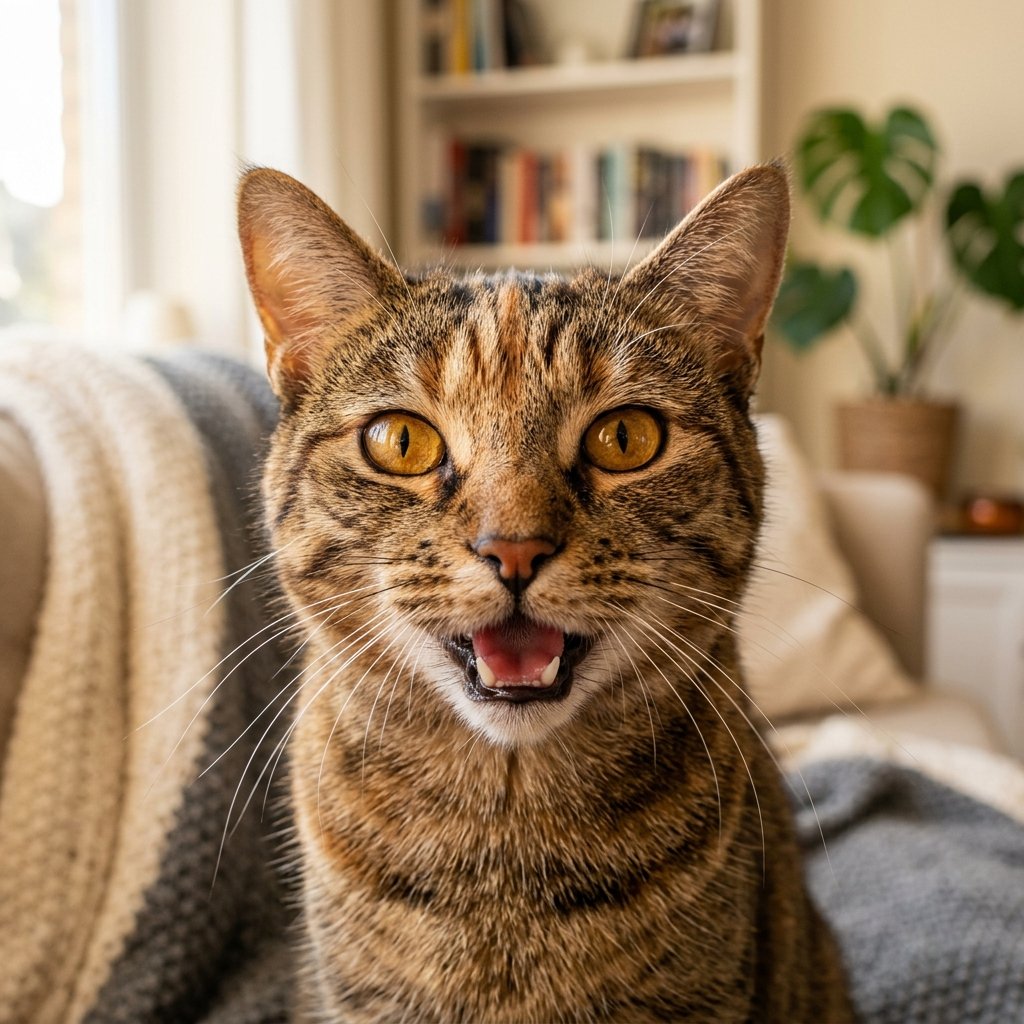
A female cat in heat will vocally communicate intensely and persistently, often called yowling rather than meowing. It can occur every few weeks and last for days at a time. Unneutered males also tend to vocalize more, particularly if they can detect a female in heat nearby.
What you can do: Spay or neuter your cat. “This is one of the most impactful things you can do for your cat’s long-term health and behavior,” the ASPCA notes.
5. Cognitive Decline in Older Cats
If your senior kitty (10+ years) has started to meow more, especially at night or in a random, disoriented fashion, this may be a sign of feline cognitive dysfunction (FCD), which is similar to dementia in humans. They may cry out because they are confused as to where they are or what time it is.
It is heart-breaking to see, but it can be managed with the right support.
What to do: Talk to your vet about cognitive support supplements, night lights to reduce disorientation and environmental changes. Don’t punish the behavior; your cat isn’t doing it on purpose.
Expert Tip: Nighttime yowling in cats over 12 years old warrants a vet visit even if everything else seems fine. Hyperthyroidism and hypertension are common in older cats and both cause increased vocalization.
6. Pain or Illness
Cats instinctively hide pain — it’s a survival mechanism from their wild ancestors. But when the discomfort becomes significant, vocalization increases. Medical causes of excessive meowing include:
| Condition | Other Signs to Watch |
|---|---|
| Hyperthyroidism | Weight loss despite good appetite, restlessness |
| Urinary tract infection | Frequent litter box visits, crying while urinating |
| Hypertension | Dilated pupils, disorientation |
| Arthritis | Reluctance to jump, stiff movement |
| Dental pain | Pawing at mouth, drooling, avoiding food |
| Kidney disease | Increased thirst, weight loss |
If your cat’s meowing has increased suddenly with no obvious environmental cause, a vet visit should be the first step — not a behavioral fix.
7. Boredom
A bored cat is a chatty cat. Indoor cats especially require outlets for their hunting instincts. If your cat is most vocal in the late evening or early morning, it may simply be that their energy has nowhere to go.
What to do: Wand toys, laser pointers, and food puzzles are great. Rotate toys to keep them from getting stale. Even a bird feeder outside a window can give hours of passive stimulation.
Common Mistakes Cat Owners Make
Punishing Meowing
Spraying your cat with water or shouting “no” doesn’t work — and it damages trust. Cats don’t associate punishment with behavior the way dogs might. You’re more likely to create a fearful cat that still meows.
Giving In Every Time
If your cat learns that meowing always gets a response — food, play, attention — you’ve trained them to meow more. The fix isn’t to ignore them entirely, but to be strategic: reward quiet behavior and don’t reward the meow directly.
Assuming It’s Behavioral When It’s Medical
This is the most dangerous mistake. Behavioral interventions won’t fix pain, hyperthyroidism, or a UTI. If you’re trying to train away a medical symptom, you’re not just failing — you’re delaying treatment.
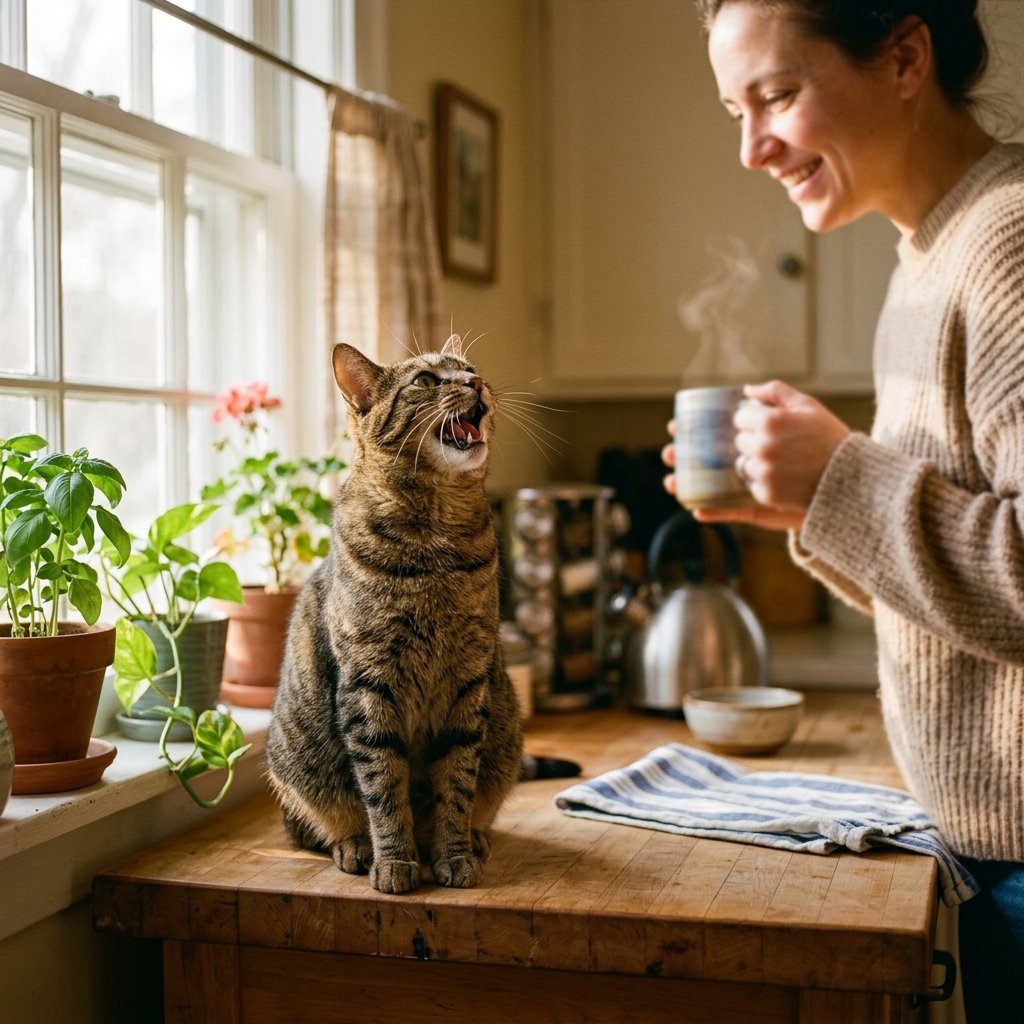
Breed Differences: Some Cats Are Just Louder
If you’ve recently adopted a new cat and are surprised by the volume, breed may play a role:
High-vocalization breeds:
- Siamese — famous for loud, persistent “talking”
- Oriental Shorthair — similar to Siamese in temperament
- Bengal — highly active and communicative
- Burmese — affectionate and vocal
- Tonkinese — social and chatty
Quieter breeds:
- British Shorthair
- Russian Blue
- Norwegian Forest Cat
- Persian
That said, individual personality varies significantly — you can have a quiet Siamese or a chatty British Shorthair. Breed is a guide, not a guarantee.
When to Call the Vet
See a veterinarian if your cat’s meowing:
- Has increased suddenly without any clear environmental trigger
- Is accompanied by changes in eating, drinking, or litter box habits
- Sounds different — more pained, raspy, or confused than usual
- Is happening mostly at night in a cat over 10 years old
- Comes with any other behavioral or physical changes
The AVMA recommends annual wellness exams for adult cats and biannual visits for seniors — these checkups often catch conditions like hyperthyroidism before they become serious.
FAQ: Real Questions Cat Owners Ask
Q: Is it normal for cats to meow all night?
Not as a regular pattern. Occasional nighttime noise is normal, but persistent nocturnal meowing — especially in older cats — often points to hyperthyroidism, cognitive decline, or simply a sleep schedule mismatch. Increasing daytime activity often helps.
Q: My cat meows right after eating. What does that mean?
Usually, it means they want more — or they want company. Some cats also meow as a displacement behavior, essentially a habit after a positive event like a meal. If it happens consistently, try engaging them in play after feeding.
Q: Can I train my cat to meow less?
Yes, within limits. You can reduce attention-seeking meowing by not responding to it (while making sure their needs are met). What you can’t train away is meowing driven by pain, illness, or instinct. Always rule out medical causes first.
Q: Why does my cat meow at walls or nothing?
This can be normal if they’re tracking sounds you can’t hear (pests in walls, high-frequency sounds). But if it’s happening frequently with a disoriented look, have your vet check for cognitive issues or sensory changes.
Q: My cat only meows when I’m home. Why?
You’re their person. Cats reserve meowing primarily for humans — so this is actually a sign of attachment. It becomes a problem only when it’s excessive or anxiety-driven. Check whether the meowing peaks after you’ve been gone for a long stretch.
What to Do Next: Your Roadmap
If you’re dealing with a cat that meows too much, here’s how to approach it systematically:
Step 1 — Rule out medical causes
Book a vet visit if the meowing started suddenly, your cat is over 8 years old, or you notice any physical changes. Don’t skip this step.
Step 2 — Audit your cat’s environment
Has anything changed recently? New pet, new schedule, new furniture? Identify potential stressors and address them with safe spaces and pheromone support.
Step 3 — Evaluate their daily routine
Are they getting enough play? Are feeding times consistent? Fix the basics before assuming a behavioral problem.
Step 4 — Stop rewarding the meow
If attention-seeking is the cause, stop responding to meowing directly. Instead, reward quiet moments with attention and treats. This takes consistency — expect it to get worse before it gets better (this is called an extinction burst).
Step 5 — Consider enrichment upgrades
Add a window perch, rotate toys, or try a puzzle feeder. If you’re away all day, a second cat might genuinely help — but that’s a long-term commitment, not a quick fix.
Step 6 — Reassess in 2–3 weeks
If you’ve made changes and nothing has improved, go back to your vet. Some causes — like early hyperthyroidism — don’t show dramatic symptoms at first.


Discussion 0 comments
Share your thoughts — every perspective adds value.