

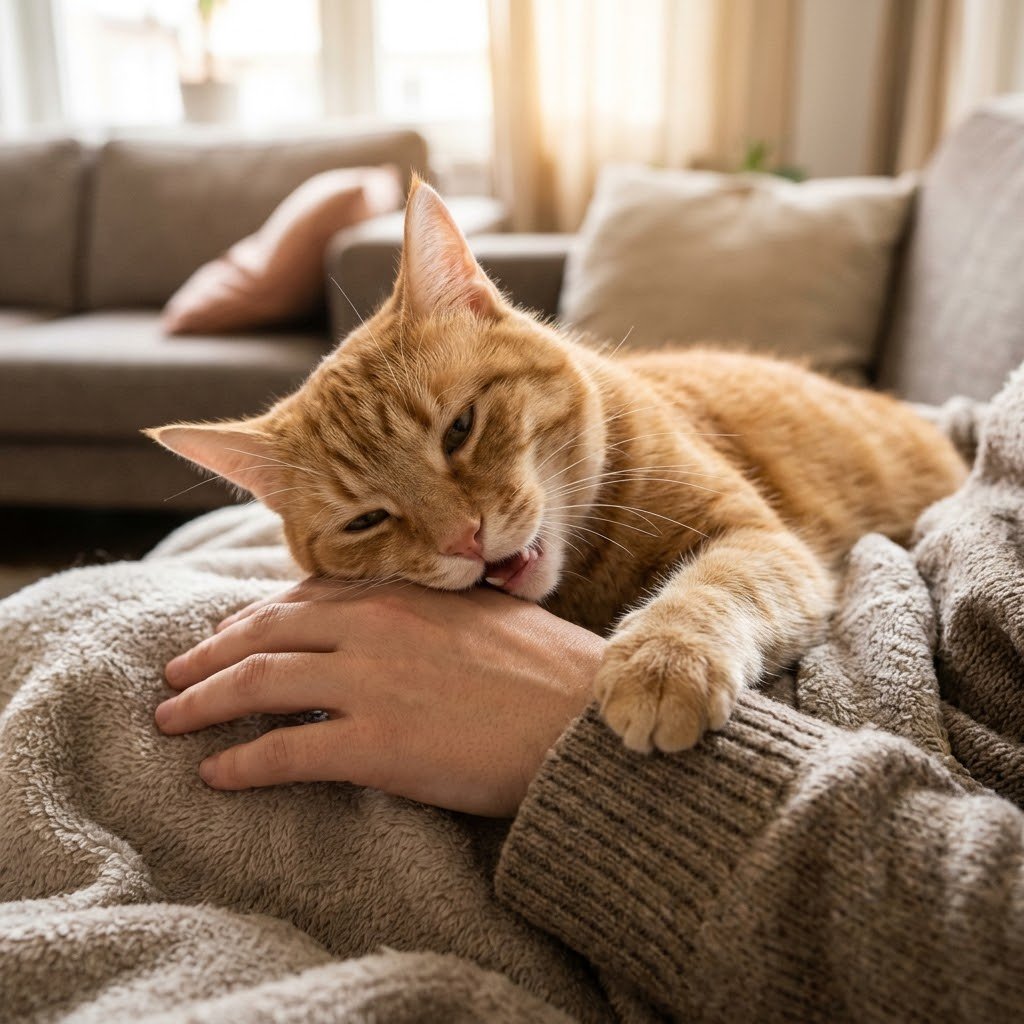
You’re on the couch, your cat is curled up against you, maybe even purring, and then it happens: a quick, soft bite on your hand or arm. No hissing, no scratching, no blood. Just teeth. So why does my cat bite me gently when everything seemed fine a second ago?
The short answer is that a gentle bite is a message, not an attack. Depending on the moment, it can mean “I like you,” “let’s play,” “that’s enough petting,” or occasionally “something hurts.” The trick is learning which one you’re getting, because the right response is different for each.
This guide walks through the most common reasons, shows you how to read the body language around the bite, and explains what to do in the moment and what to avoid.
The Quick Answer: What a Gentle Cat Bite Usually Means
Before going deep, here’s a fast way to narrow it down. Look at when the bite happens and what the rest of your cat’s body is doing.
| What you notice | Most likely meaning |
|---|---|
| Soft nibble mixed with licking, cat relaxed and purring | Grooming or affection (a “love bite”) |
| Bite after a few minutes of stroking, tail starts flicking | Overstimulation: your cat wants the petting to stop |
| Pounce on moving hands or feet, wide pupils, wiggling rear | Play or hunting practice |
| Nip when you’re on your phone or ignoring them | Attention-seeking |
| Young kitten chewing on everything, including you | Teething and learning bite strength |
| Bite when you touch one specific spot, especially if new | Possible pain: worth a vet check |
Why Does My Cat Bite Me Gently? 7 Common Reasons
1. It’s a love bite
Many cats give soft, controlled bites when they feel content and close to you. These “love bites” rarely leave a mark. They often come with purring, slow blinks, kneading, or rubbing their face on you.
Cat behavior experts don’t fully agree on what love bites mean. Some see them as pure affection. Others, including Cats Protection, point out that a cat who licks and then bites may be getting a little overexcited. In practice, both can be true: the bite starts as affection and tips over when the cat gets too wound up. If the nips stay soft and your cat stays relaxed, there’s usually nothing to worry about.
2. Your cat is grooming you
Cats that live together groom each other, a behavior called allogrooming. Watch two bonded cats and you’ll see they don’t just lick. They also nibble to work through tangles and pull out loose fur. When your cat licks your hand and then adds a few small bites, they may simply be treating you like one of the group.
If your cat also licks you a lot, our guide on why your cat licks you explains the rest of that grooming picture.
3. Too much petting (overstimulation)
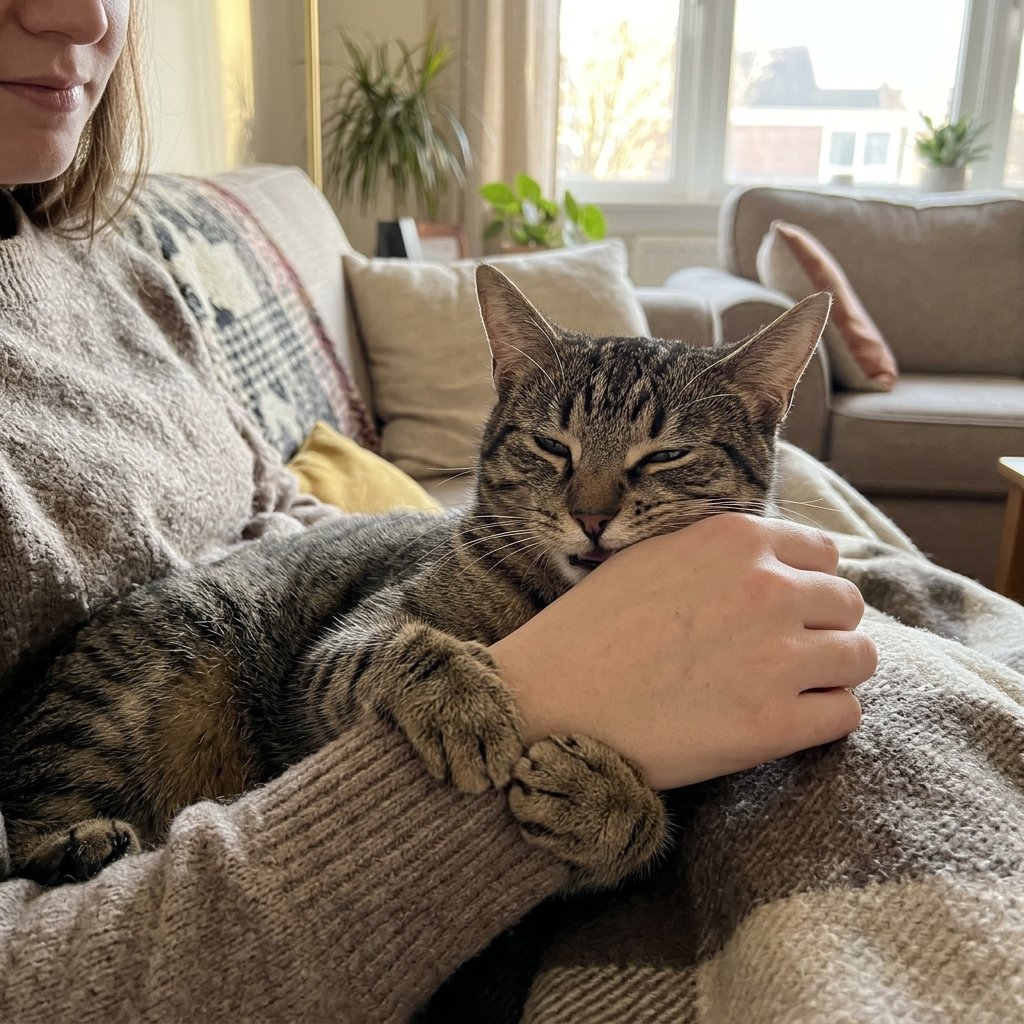
This is the reason that surprises owners most. Your cat comes to you, enjoys being stroked, and then turns and bites, often gently, sometimes harder. Vets call this petting-induced aggression, though in most cases it’s closer to a firm “stop” than real aggression.
Nobody knows for certain why it happens. The Cornell Feline Health Center notes that the cause remains unknown, and that the leading ideas are that repeated touching becomes unpleasant, or that the cat simply wants control over when the contact ends. Either way, the bite is the end of a conversation your cat has usually been having for a while with its body.
Every cat has a different limit. Some enjoy ten minutes of chin scratches. Others are done after a few strokes along the back. Many cats tolerate head and cheek rubs far better than belly or tail-base touching.
4. They want to play
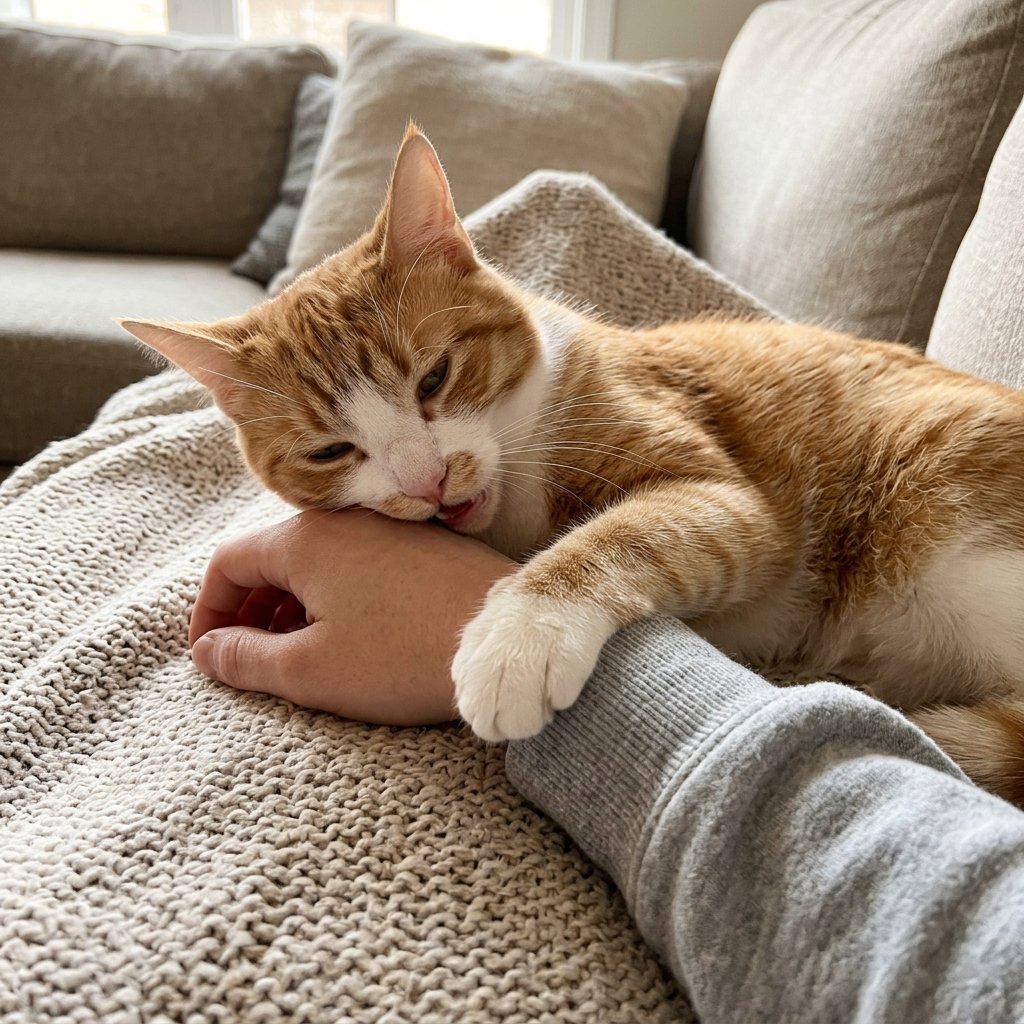
Cats are built to stalk, pounce, and bite. Indoor cats don’t get to hunt, so that energy has to go somewhere, and a hand moving under a blanket looks a lot like prey. Play bites usually come with a crouch, a wiggling rear end, wide pupils, and a sudden pounce.
This is especially common in cats who were played with using fingers as kittens. Cornell notes that play aggression is often seen in young cats, particularly those that weren’t raised with littermates, since siblings teach each other how hard is too hard.
5. Attention, please
Cats learn quickly what gets a reaction. If a little nip makes you put down your phone, look at them, talk to them, or get up to fill the food bowl, your cat will remember it. Attention bites are usually light and well-aimed, and they tend to happen at predictable times like early morning or when you sit down to work.
Cats that follow you everywhere are often the same cats who use a gentle nip to ask for more of you.
6. Teething and learning (kittens)
Kittens explore the world with their mouths. They lose their baby teeth and get adult teeth between roughly three and six months of age, and chewing can ease that discomfort. They’re also still learning bite inhibition, meaning how much pressure is okay. A kitten that bites gently today can bite harder as an adult if it learns that hands are toys, so this is the best age to redirect the habit.
7. Something hurts
This one matters most. If gentle biting is new, if it happens every time you touch one area (hips, back, mouth, belly), or if it comes with other changes like hiding, less grooming, or eating less, pain is a real possibility. Cats are very good at hiding discomfort, and a bite may be the clearest signal they can give. Cornell lists conditions such as arthritis and dental disease among the medical issues vets rule out when a cat’s biting changes.
Reading the Signs Before the Bite
Most cats warn you before they bite. The signals are subtle, which is why the bite feels like it came “out of nowhere.” Keep an eye on these:
- Tail: a tip that starts to twitch or a tail that thumps or lashes against the couch.
- Skin: a ripple or twitch along the back when you stroke it.
- Ears: ears rotating sideways or flattening back.
- Eyes: pupils suddenly getting wide, or a hard stare at your hand.
- Body: stiffening, stopping the purr, or turning the head toward your hand.
- Paws: grabbing your arm, sometimes with back legs starting to kick.
If you notice even one of these, stop petting and let your cat decide what happens next. Pulling your hand away slowly and calmly is better than snatching it, since fast movement can trigger a chase. If your cat seems on edge often, not just during petting, our article on signs your cat is stressed can help you spot what else might be going on.
What to Do When Your Cat Bites You Gently
Your response depends on the reason, but these steps work for most gentle biters:
- Freeze, then end the interaction. Stop moving your hand. Once your cat lets go, calmly get up or move your hand away. The lesson is simple: biting ends the fun.
- Keep petting sessions short. Stop before your cat’s limit, not after. If the bite usually comes at minute three, stop at minute two.
- Stick to favorite spots. Cheeks, chin, and the top of the head are safer for most cats than the belly, legs, or base of the tail.
- Redirect play bites to toys. Wand toys, kicker toys, and small balls let your cat bite and bunny-kick something that isn’t you. Keep a toy nearby on the couch.
- Schedule real play. Two or three short, active play sessions a day that end with a “catch” and a treat can reduce bites driven by pent-up energy.
- Don’t reward attention bites. If your cat nips for attention, calmly turn away. Give attention when they ask nicely, like sitting beside you or meowing softly.
- Reward calm contact. Cornell suggests pairing short, gentle petting with treats so your cat links your touch with good things.
For a full training plan, including cats whose bites are harder or more frequent, see how to stop a cat from biting.
What Not to Do
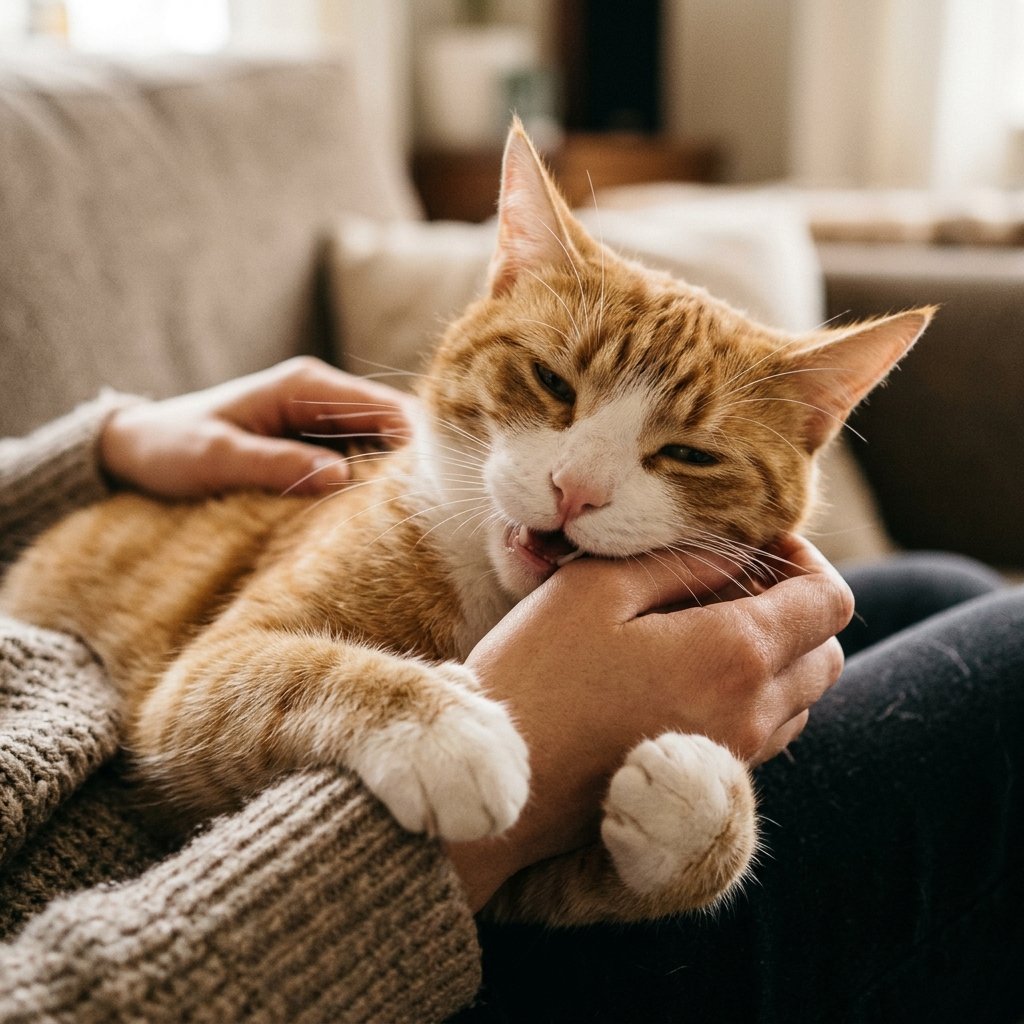
- Don’t punish your cat. Tapping the nose, yelling, or spraying water doesn’t teach a cat why biting is wrong. Cornell warns that physical punishment can increase fear and anxiety and make aggression worse.
- Don’t use your hands as toys. Wiggling fingers under a blanket is fun with a kitten and a problem with an adult cat.
- Don’t jerk your hand away. It can turn a soft bite into a harder one or start a chase game.
- Don’t keep petting through the warning signs. Your cat will learn that subtle signals don’t work and may skip them next time.
Why Does My Cat Bite Me Gently While Purring?
Purring tells you your cat is in a strong emotional state. Most of the time that’s contentment, which is why a purring cat that nibbles is often giving a love bite. But cats also purr when they’re excited, and the line between relaxed and overexcited can be thin. If the purring stops, the tail starts moving, or the bites get firmer, treat it as overstimulation and end the cuddle. You can learn more about the different reasons cats purr in our guide to why cats purr.
Why Does My Cat Bite Me Gently and Not Other People?
This often comes down to trust and habit. Cats tend to save grooming bites and play bites for the person they’re most bonded with, and that’s usually the person who spends the most time with them. It can also be learned: if you’re the one who plays rough or reacts the most to nips, you’ve become the most interesting target. Cats that choose to sleep on you and knead you are showing the same kind of close bond.
When a Gentle Bite Is a Reason to See the Vet
Most gentle biting is normal cat behavior. Book a vet visit if:
- The biting is new, or your calm cat suddenly starts biting more.
- Your cat bites every time you touch one body part.
- You notice other changes: hiding, a messy coat, drooling, bad breath, eating less, limping, or litter box changes.
- Gentle bites are turning into hard bites, or your cat is biting other pets or children.
Ruling out pain first saves a lot of frustration, since no amount of training will fix a bite that’s caused by a sore mouth or stiff joints.
What If a Gentle Bite Breaks the Skin?
Even a small cat bite can be deeper than it looks. Cats have narrow, sharp teeth, and their mouths carry bacteria (including Pasteurella) that can cause infections. If a bite breaks the skin, wash it right away with soap and warm running water, cover it with a clean dressing, and keep an eye on it. Contact a doctor promptly if the bite is on your hand or near a joint, if it’s deep, if you have a weakened immune system, or if you notice redness, swelling, warmth, pain, or pus over the next day or two.
Frequently Asked Questions
Are cat love bites a good sign?
Usually, yes. Soft bites that come with purring, licking, and relaxed body language generally mean your cat feels safe with you. Just watch for the moment the mood shifts.
Why does my cat bite me gently and then lick me?
Bite-then-lick is classic grooming behavior. Cats groom each other with the same mix of licks and small nibbles. It can also signal growing excitement, so if the bites get harder, end the session.
Why does my cat grab my arm and bite it?
Grabbing with the front paws and biting, sometimes with back-leg kicks, is usually play or a hunting-style move. It can also mean you’ve petted past your cat’s limit. Give your cat a kicker toy to grab instead.
Should I let my cat bite me gently?
Soft affectionate nibbles that never leave a mark are fine for many owners. Still, it’s wise not to encourage biting as a game, because what’s gentle today can get harder with excitement. Offer toys for play and end cuddles calmly when the nips start.
Will my kitten grow out of biting?
Many kittens bite less as they mature, especially once their adult teeth are in. But kittens that learn that hands are toys often keep doing it as adults. Redirecting to toys now is the best way to raise a gentle adult cat.
The Bottom Line
If you’ve been asking yourself “why does my cat bite me gently,” the answer is that your cat is talking to you. Most soft bites are about affection, grooming, play, or a polite request to stop petting. Learn your cat’s warning signs, keep cuddles short and sweet, give their hunting instincts a proper outlet, and check with your vet if the biting is new or linked to touch in one area. With a little attention, those surprise nips become much easier to read and much less frequent.


Discussion 0 comments
Share your thoughts — every perspective adds value.