

Few things cause more worry for pet owners than the moment a dog and a cat first meet. Will the dog chase? Will the cat hiss, swipe or hide in a cupboard for a week? The stories you’ve probably heard range from “they became best friends” to “never again,” and the truth is that both can happen.
The good news is that many dogs and cats do learn to live together, and some become real companions. The difference usually comes down to how the introduction is done. If you’re wondering how to introduce a dog to a cat, the secret is to go slowly, keep everyone safe and let each animal set the pace. Here’s a step-by-step approach that works for most households.

First, Is This Pairing a Good Idea?
Before you start, think about both animals honestly.
Your dog
- Prey drive: Dogs bred to chase or hunt small animals, such as many terriers, sighthounds, herding breeds and some hounds, may find a running cat hard to resist. That doesn’t make it impossible, but it needs more care.
- History with cats: A dog who has lived with cats before, and been calm, is a much better candidate. If you’re adopting, ask the shelter whether the dog has been cat-tested.
- Training: A dog who can sit, stay and respond to “leave it” is far easier to manage.
- Age and energy: A bouncy puppy can overwhelm a shy cat, and an exuberant young dog may be too much for a senior one.
Your cat
- Temperament: A confident, curious cat usually does better than a shy or fearful one.
- History with dogs: A cat who has lived with dogs is less likely to panic.
- Health: Stress can make cats unwell, so make sure your cat is healthy. Our guide to the signs your cat is stressed can help you watch for problems.
If either animal seems very anxious, aggressive or intensely predatory, talk to your vet or a qualified behavior professional before starting.
Step 1: Prepare Your Home
Good preparation makes everything easier.
- Create a cat-only space. Set up a room, or part of one, where your cat can retreat. It should have food, water, a litter box, a bed and hiding places, and be inaccessible to the dog. A baby gate that dogs can’t get through, or a door, works well. Use a door latch to prevent surprises.
- Provide vertical space. Cats feel safer when they can get up high. Cat trees, shelves and sturdy furniture give your cat escape routes and viewing spots.
- Keep the litter box out of reach. Dogs sometimes raid litter boxes, and cats don’t like to be disturbed when using them.
- Feed separately. Keep food bowls apart, so neither animal feels threatened while eating.
- Trim nails and make a plan. Short nails reduce the risk of scratches, and you’ll want a plan for who does what during introductions.
If you’re bringing a new dog home, our guide to how to introduce a new dog to your home covers the wider process, including settling in with the whole family.
Step 2: Teach Your Dog the Basics First
Before the animals meet, make sure your dog knows a few essential skills, and practice them with treats. The most useful are “sit,” “stay,” “leave it” and “come.” These give you a way to redirect your dog, and they help your dog stay calm around the cat.
Our basic dog commands training plan and how to teach a dog to stay walk through building these skills step by step, and positive reinforcement dog training explains how to reward calm behavior. Make sure your dog has had plenty of exercise before each introduction, because a tired dog is a calmer one.
Step 3: Start With Scent, Not Sight
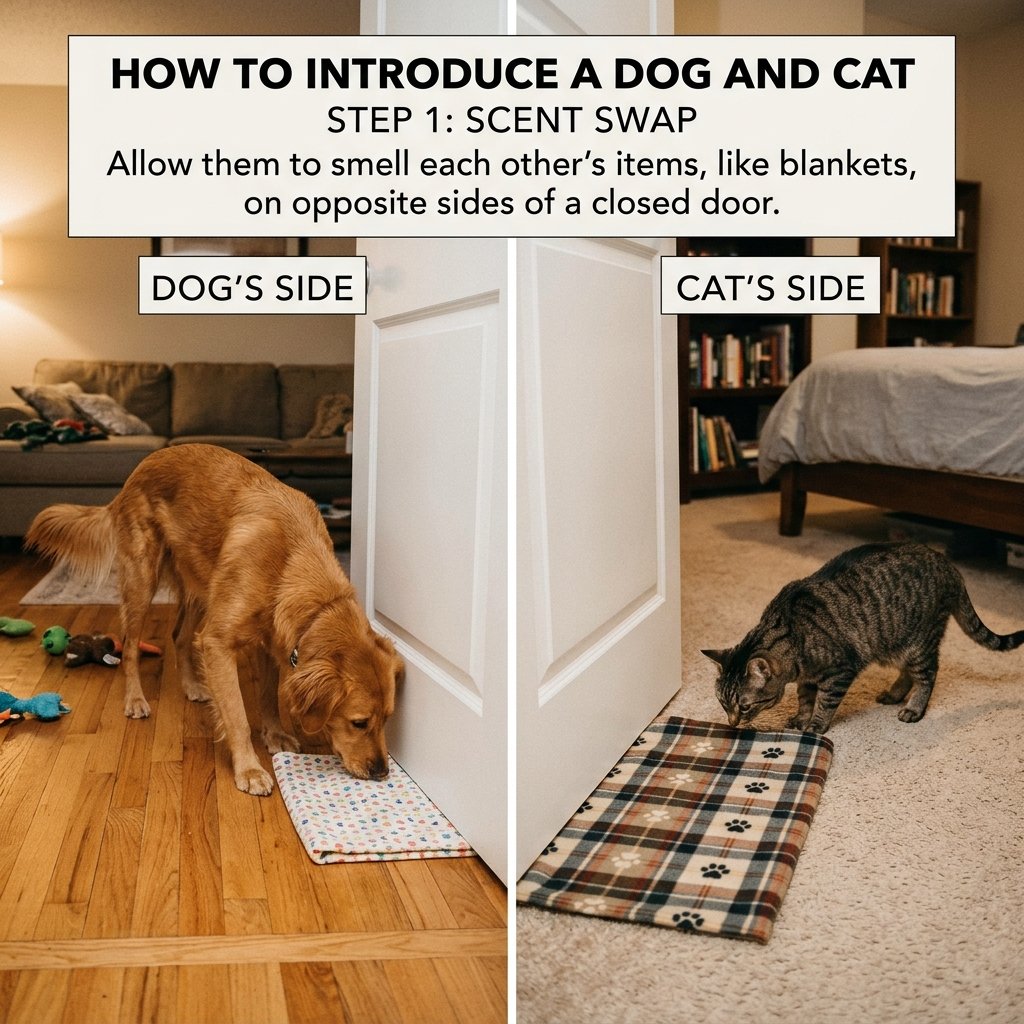
Animals learn about each other through smell long before they come face to face. Begin by keeping them in separate areas and letting them get used to each other’s scent.
- Swap bedding or blankets between the two, so each animal can sniff the other’s smell.
- Rub a soft cloth on one animal, such as around the cheeks for a cat, and let the other sniff it while you give treats.
- Feed them on opposite sides of a closed door. They’ll learn that the other animal’s smell means something good, like dinner. Gradually move the bowls closer to the door over several days, if both stay calm.
Step 4: Visual Introductions Through a Barrier
Once both animals are relaxed about the scent, let them see each other, but from a safe distance, with a barrier in between.
- Use a baby gate, a screen door or a door open just a crack.
- Keep the dog on a leash, and ask them to sit or lie down calmly. Reward calm behavior with treats.
- Reward the cat as well, with treats or play, for staying relaxed.
- Keep sessions short, a few minutes at a time, and end on a positive note.
- If your dog fixates, lunges, barks or whines, or your cat hisses, puffs up or flees, increase the distance or end the session. Try again later.
Repeat this over several days or weeks, until both animals can look at each other without a big reaction. Don’t rush. This is the stage that determines how well the rest goes.
Step 5: The First Face-to-Face Meeting, on Leash
When both seem calm, it’s time for a controlled meeting.
- Exercise your dog first. A walk or play session before the meeting helps your dog stay calm.
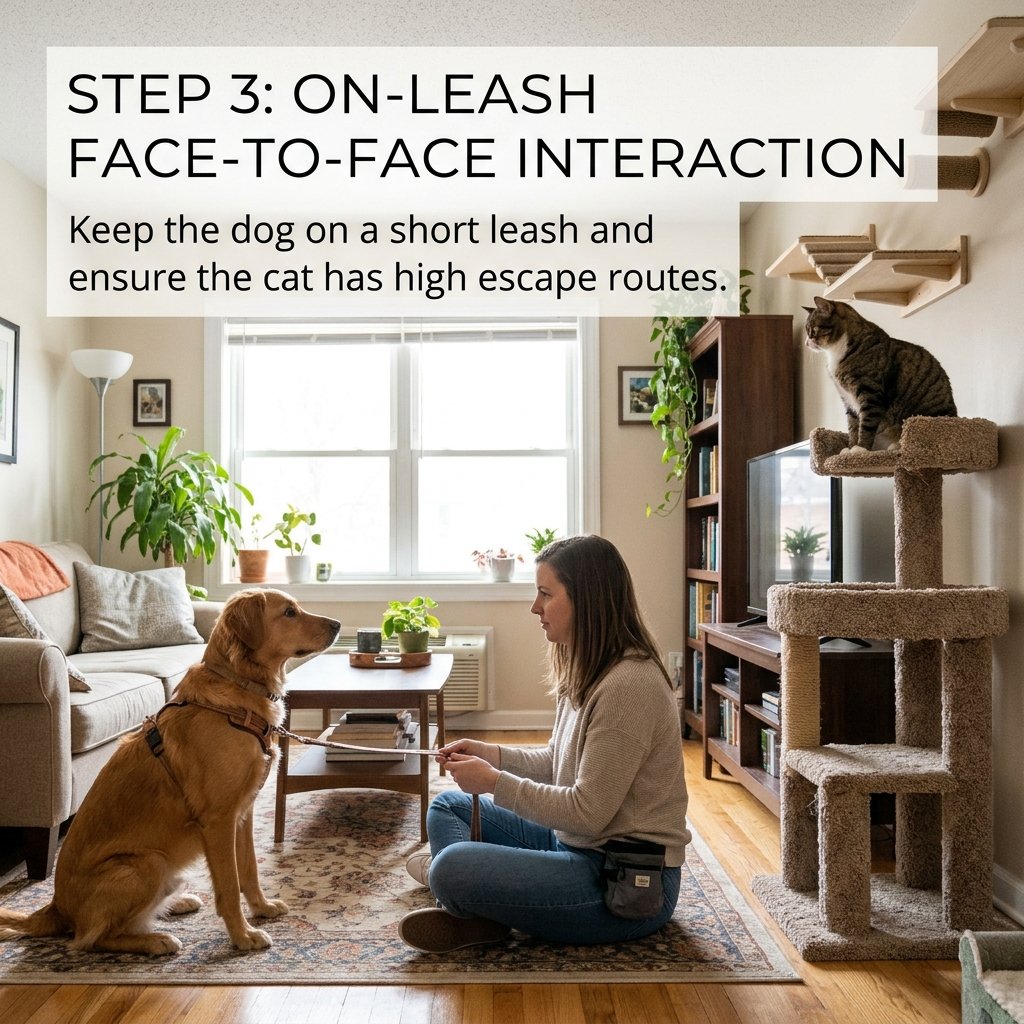
- Keep your dog on a leash, and keep it loose, with a handler who can control them. A harness can help.
- Let the cat choose. Don’t hold or carry your cat. Make sure they can leave and have a high place to go. Never trap or corner them.
- Reward calm behavior, with treats for your dog when they look at the cat and look away, and treats or praise for the cat.
- Keep it short, a few minutes at most, then calmly separate them. End while everything is still going well.
- Repeat daily, gradually increasing the time as both animals relax.
Reading Body Language
Knowing what each animal is saying makes it easier to keep everyone safe.
Signs that things are going well
- Dog: loose, wiggly body, soft eyes, looking away and returning to you, sniffing the ground
- Cat: relaxed posture, tail up or loosely held, slow blinking, exploring, eating or grooming
Signs to slow down or stop
- Dog: stiff body, hard stare, fixating on the cat, drooling, whining, barking, lunging, trying to chase or stalk
- Cat: flattened ears, wide eyes, puffed tail, arched back, hissing, growling, swatting or trying to flee
Predatory behavior is the biggest red flag. A dog who goes still, stares intensely, stalks, or lunges at the cat with silent focus may be in prey mode. Stop the session calmly, increase distance and talk to a professional. Your cat’s safety comes first. Our article on why your dog growls at you can help you read and respond to warning signals.
Step 6: Gradual, Supervised Time Together
Once meetings on leash go well for several days or weeks, you can start letting the animals share space with more freedom, with careful supervision.
- Allow the dog off leash in the same room with the cat, but keep a leash trailing so you can step in.
- Make sure the cat has easy access to escape routes and high spots.
- Keep an eye out for chasing or cornering, and interrupt calmly if it happens.
- Gradually extend the length of these sessions.
- Continue to separate them when you can’t supervise, such as when you’re out or asleep, for weeks or even months.
Never leave the two alone together until you’re completely confident. That may take a long time, and in some households, it never becomes safe. That’s okay. Many dogs and cats happily share a home with part-time separation.
Introducing a Puppy to a Cat
Puppies can be a good match, since they’re still learning, but they’re also bouncy, and cats may find them overwhelming. Teach your puppy to settle, give the cat plenty of safe spaces and never allow chasing. Set aside quiet time for your cat away from the puppy. Our puppy care tips for beginners and how to calm a hyper puppy have helpful routines.
Introducing a Kitten to a Dog
Kittens are small and fragile, and even a friendly dog can accidentally hurt one. Supervise closely, keep the kitten safe in its own space when you’re not watching and introduce them very gradually. Teach your dog to be gentle, and consider waiting until your kitten is a bit bigger if your dog is very exuberant.

Keeping the Peace Long Term
- Respect the cat’s space. Always keep an escape route, and never let the dog chase.
- Feed separately, and keep the cat’s food and litter box out of the dog’s reach.
- Provide vertical territory in every room they share.
- Exercise and entertain your dog, so they’re less likely to pester the cat. See our guide to healthy habits for pets for daily routines.
- Play with both animals, and give each one individual attention.
- Keep claws trimmed, and watch for stress signs.
If your cat starts hiding, going to the toilet outside the box or becoming aggressive, it may be stress. Our guides on why your cat hides, why a cat pees outside the litter box and how to stop a cat from biting can help you work out what’s going on.
Common Mistakes
- Rushing the introduction or letting them meet with no preparation
- Forcing contact or holding the cat
- Letting the dog chase, even in play
- Skipping leashes, gates or escape routes
- Punishing either animal for reacting
- Leaving them alone together too soon
- Ignoring signs of stress or predatory behavior
When to Call a Professional
Speak to your vet, and a certified trainer or veterinary behaviorist, if:
- Your dog shows intense predatory behavior
- Your cat is extremely fearful or stops eating, drinking or using the litter box
- Either animal injures or tries to injure the other
- You’re not making progress after several weeks
The ASPCA’s pet care pages, International Cat Care, the Cornell Feline Health Center and Fear Free all offer useful advice. And the American Veterinary Society of Animal Behavior explains why reward-based methods are preferred in its position statements. For a cat-friendly vet, you can search at catfriendly.com.
How Long Does It Take?
Every pair is different. Some dogs and cats are comfortable within days, but many need weeks or months. Go at the speed of the more nervous animal. Rushing almost always backfires, while patience pays off.
Quick Answers
How long does it take to introduce a dog to a cat?
Anywhere from a few days to several months. Take it at the pace of the more anxious animal.
Should I keep my dog on a leash when meeting a cat?
Yes, for the early meetings. It helps you control the situation and keeps both animals safer.
What if my dog is obsessed with the cat?
Increase distance, use training and treats to teach calm behavior and get professional help if the fixation is intense or predatory.
What if my cat hisses at the dog?
Hissing is a normal warning. Give your cat space and slow down. It doesn’t mean it won’t work out.
Can any dog live with a cat?
Not every dog can, especially those with strong prey drive. Some can live together with careful management, and some should be kept separate.
Is it easier to introduce a puppy or an adult dog to a cat?
It depends. Puppies can learn good habits but are bouncy, while calm adult dogs with a history of living with cats are often a good match.
The Bottom Line
When it comes to how to introduce a dog to a cat, patience is everything. Prepare safe spaces, start with scent, move to barrier introductions, then leashed meetings, and watch body language at every step. Never force interaction, keep your cat’s escape routes open and reward calm behavior in both animals. With time, many dogs and cats go from wary strangers to comfortable housemates, and sometimes to the best of friends.
If either animal shows intense fear, aggression or predatory behavior, or if anyone is injured, speak with your veterinarian or a qualified behavior professional.




Discussion 0 comments
Share your thoughts — every perspective adds value.